
Melee Combat
Left-click to strike, and anyone within your weapon’s reach is hit. How heavy the blow is depends on how long it has been since your last blow, the skill gap between you and the target, and what you are holding. The attack bar below the crosshair shows how much force a blow would have right now; wait until the bar is full and the blow becomes a big attack that hits several people at once.
Attack interval
Link to the “Attack interval” sectionEvery weapon has an attack interval in your hands: strike once every interval and each blow has exactly full force. Force, the attack bar, and big attacks below are all measured in this interval.
What makes the interval shorter:
- The skill for that weapon class, and Dexterity: the skill counts for seventy percent and Dexterity for thirty. With both fully trained, the interval is a little over half.
- A light weapon: within one class, the heavier the weapon, the longer the interval.
What makes the interval longer:
- Not enough Strength: each level by which the weapon’s Strength requirement exceeds your Strength makes you 1.5% slower, up to thirty percent slower at a gap of 20 levels or more. Strength above the requirement gives nothing extra.
- Injured arms: if your main hand (the right) is unusable, attack speed drops to about a third; if the other hand is unusable, it halves.
- Carrying too much, wearing a backpack, and some heavy armour.
For comparison: a Katana in a beginner’s hands strikes about every 0.55 seconds, and about every 0.3 seconds with the skill and Dexterity fully trained. The Falling Sun goes from about 0.9 seconds to about 0.5 seconds, and the Fragment Axe from about 1 second to about 0.55 seconds. Unarmed is faster than any weapon; see Martial Arts.
The attack bar and force
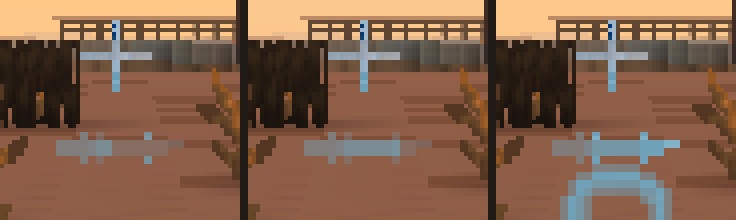
Link to the “The attack bar and force” sectionThe attack bar below the crosshair empties every time you strike, then fills again. It has two notches:
| Attack bar | Time since the last blow | Striking now |
|---|---|---|
| Before the first notch | Less than half an interval | You can’t strike yet. A left-click now is held and goes out when the bar reaches the first notch |
| First notch | Half an interval | The earliest you can strike; this blow has half force |
| Between the notches | Half to one interval | Force rises steadily with the wait |
| Second notch | One interval | Full force |
| Past the second notch | More than one interval | Still full force; waiting longer doesn’t make it heavier |
| Full, with the big attack icon | One and a half intervals | Big attack |
Force decides the blow’s damage, the XP you get, and how much the target resents you.
Rapid clicking and waiting for full force do the same total damage per second. A blow at the first notch has only half force, but in the same time you get two of them. The difference is in how the damage is spread: rapid clicking can spread damage across more people or switch targets, while a full-force blow is more likely to make the target stagger (see Staggering below).
- If you left-click while the previous swing is still under way, that click is held too and goes out when the swing finishes.
- An ordinary attack is just a plain arm swing. A swing that misses still makes the swing sound, the same set as a blow that lands.
- Changing what you hold resets the attack bar to empty.
Big attacks
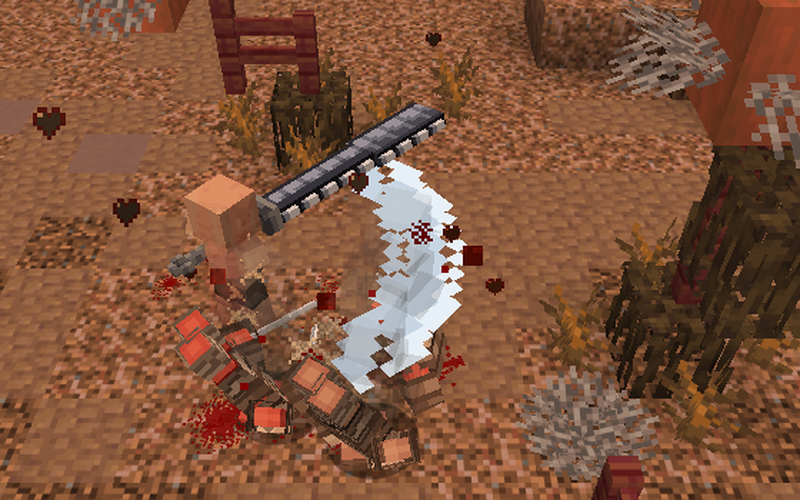
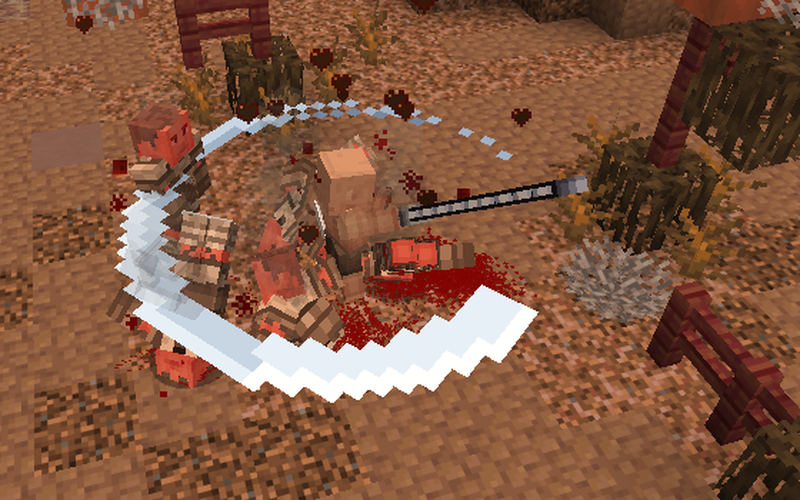
Link to the “Big attacks” sectionA blow struck once the attack bar is full (one and a half intervals) is a big attack: a fan in front of you, or a spin on the spot, and every enemy in range is hit.
- The angle depends on the skill for that weapon class. A beginner only covers about 50° in front. The higher the skill, the wider the fan: at level 50 it is 135° and becomes a turning sweep, and from level 80 it spins a full circle. The angle is the same for all six classes.
- The number of people depends on the weapon class and the skill. Heavy Weapons hit the most: 3 people for a beginner and 12 at level 80. Katanas hit the fewest, 3 at level 80. The numbers for each class are in the Data table.
- The person you are aiming at takes full force. The others take full force too with Heavy Weapons and Blunt, eighty percent with Hackers and Polearms, and seventy percent with Katanas and Sabres. When a polearm sweeps someone standing within 1.5 blocks of you, that damage is halved again.
- With Katanas at level 50 or below, the big attack isn’t a fan but two cuts in a row at the one person in front of you; together the two cuts make one full-force blow.
- The radius is your reach.
- A big attack takes a little longer to start than an ordinary one, and being hit doesn’t interrupt it. Afterwards you go straight back to your guard, and the next blow is worked out as usual.
- While you aren’t striking, the attack bar keeps filling: standing idle, blocking, moving around, and dodging all count. So the first blow of a fight, and the first blow after a pause, are big attacks.
A big attack only sweeps people who are hostile to you, including whoever you are fighting. Your own side, bystanders, captives, people being carried, and people who are down are never swept, and neither are other travellers.
When the angle is 180° or more, the area of the blow is drawn at your feet the moment it starts.
Blade trails and particles
Link to the “Blade trails and particles” sectionAn ordinary attack has no blade trail. When a weapon blow lands, a sweep of particles appears in front of you; from 55% power upward, critical-hit stars are added, more and spread wider the closer it is to full force, so you can use them to judge your rhythm. A blow that does no damage shows no particles, and neither does unarmed Martial Arts.
| This blow | What you see |
|---|---|
| Ordinary attack | No blade trail; a sweep of particles when it lands, plus critical-hit stars from 55% power |
| Big attack | A waist-high sheet of blade trail in a fan at the actual angle; a full circle only when it spins all the way round |
| Jump attack | A trail carried all the way down to the ground |
| Crouching thrust | A small flash where the thrust lands |
The outer edge of the trail is the furthest the blow can reach. You only see blade trails if you accept the look the server offers (see Joining the Server). Two-handed weapons are always swung in both hands in first person.
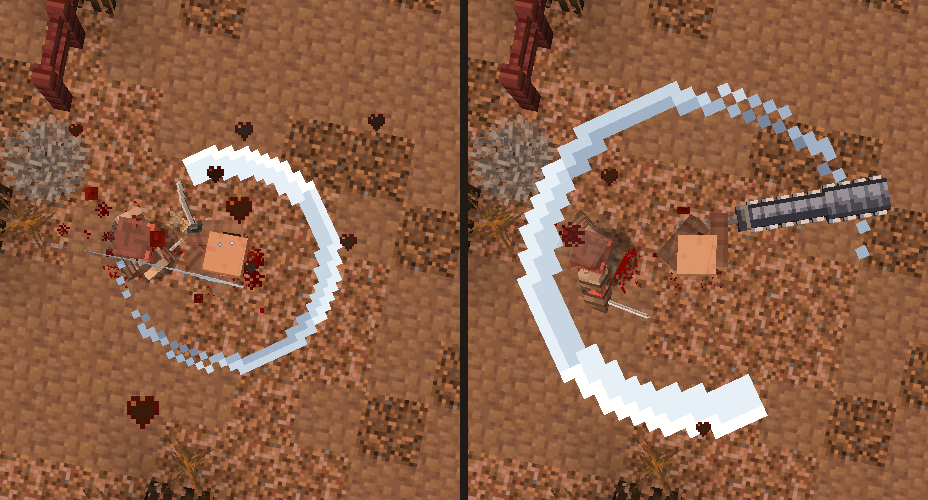
Reach is measured from the centre of your body to the tip of the blade, and is set by the weapon’s length. You only hit when the edge of the target’s body on the side facing you is within this distance; a swing from outside it hits nothing and deals no damage. The radius of a big attack and the outer edge of the blade trail use the same number.
| Weapon | Reach |
|---|---|
| Wakizashi, Flesh Cleaver | 1.5 blocks |
| Short-Cleaver | 1.55 blocks |
| Jitte, Iron Club, Iron Stick, Mercenary Club, Spiked Club, Holed Sabre, Horse Chopper, Moon Cleaver | 1.6 blocks |
| Combat Cleaver | 1.66 blocks |
| Foreign Sabre, Longsword, Ringed Sabre | 1.71 blocks |
| Katana, Guardless Katana, Ninja Blade, Heavy Jitte | 1.76 blocks |
| Desert Sabre | 1.81 blocks |
| Paladin’s Cross, Staff | 1.86 blocks |
| Falling Sun, Nodachi, Topper, Long Cleaver | 1.97 blocks |
| Heavy Polearm, Naginata Katana | 2.02 blocks |
| Naginata, Polearm | 2.12 blocks |
| Plank, Exile Plank | 2.23 blocks |
| Fragment Axe, Bull Horn Axe | 2.33 blocks |
| Fist | 1 block |
| Kick | 0.81 blocks |
The “Reach” line in a weapon’s description box shows this number (to one decimal place). Residents use the same table; for races with a larger body, the distance is scaled up a little by body size.
The damage of one blow
Link to the “The damage of one blow” sectionThe damage of a blow is these things multiplied together:
- What you are holding: weapons of this world have a base of 6; anything else (ordinary swords, tools) only 1. Unarmed punches are worked out differently; see Martial Arts.
- Force: from half to full, by the attack bar above.
- Skill gap: for every level your attack value is above the target’s defence value, 2.5% more; for every level below, 2.5% less. At least ×0.55, at most ×1.45.
- Other multipliers: being malnourished, an unusable arm, and wearing heavy armour all reduce it further (see What weakens you below).
For comparison: a full-force blow from a weapon of this world with maxed skills is exactly 50 points, and a body part has at most 100 health. Two fighters of the same level trade blows of about 35 points. None of this counts the weapon’s multipliers or the target’s armour yet. Weapons don’t differ in their base but in their cutting and blunt multipliers; see Damage Types and Weapons.
Attack value = Melee Attack skill (Martial Arts when unarmed) + the weapon’s attack bonus + the attack penalty of the armour you wear + the indoor modifier + the backpack penalty. Inside a building, when the indoor modifier of your weapon is negative, the positive bonuses from the weapon, armour, and backpack don’t count at all; only that negative modifier is left.
Striking after a jump and striking while crouched each have their own effects; see Special Moves. A blow struck while leaving the ground by walking down a slope or step counts as one struck on the ground.
Hit where you aim
Link to the “Hit where you aim” sectionThe part of the target under your crosshair is the part you hit: Head, Chest, Stomach, Left Arm, Right Arm, Left Leg, or Right Leg. The same goes for people lying down, being carried, or crouching; it follows their posture at that moment. Aim at the head and you hit the head.
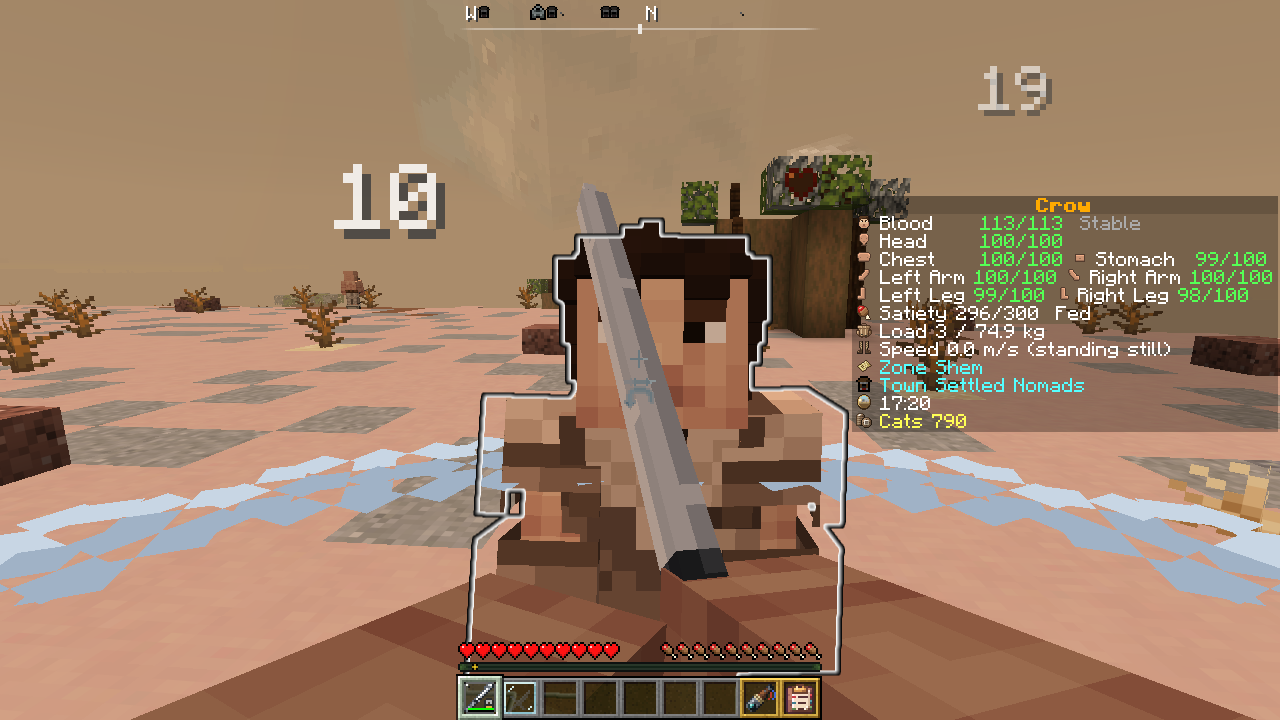
- Finishing blow: a blow on someone unconscious always lands on the chest, with damage ×1.5.
- Crouching thrust: crouch and strike once the attack bar is full for a precise thrust at one person. If your crosshair isn’t right on them, it lands on the part closest to the crosshair, which makes it good for targeting one part. See Special Moves.
- Stumps: if your crosshair is on a part that has been severed and has no prosthetic, the blow goes to the neighbouring part of the torso instead (an arm goes to the chest, a leg to the stomach).
When your crosshair isn’t on them and the blow only lands through the selection leeway described below, you don’t choose which part it hits. In that case wounds focus: once a part has been hit, it is more likely to be hit again, the more so the more hits it takes, and it only slowly returns to normal after a while. Others always hit you this way, so when you are surrounded, the same leg is often hit again and again until it breaks. The part that knocked someone out stays especially likely to be hit until its health is back above 0.
Aiming help
Link to the “Aiming help” sectionSelection leeway: if your crosshair is only slightly off (within a very narrow cone in front of your view), the blow still lands, on the nearest person in that cone. Your reach doesn’t grow because of it: people outside your reach still can’t be hit. If the person you clicked on is still within reach and still in front of you when the blade arrives, you hit them; only if they have moved away does the blow look for whoever is in front of your crosshair.
In a fight, standing enemies come first: if your crosshair is on someone who is down, a corpse, or someone being carried, while a standing enemy within reach is in front of you, the blow goes to that enemy. In that case it is also that enemy who glows.
Swinging at the air: still counts as a strike and resets the attack bar. If someone happens to be within reach in front of your crosshair when the swing arrives, they are hit.
Hitting through grass: with tall grass, flowers, ferns, or other plants you can walk through in between, the blow still reaches the person behind them, and the grass isn’t cut.
People you can’t hit
Link to the “People you can’t hit” sectionA left-click can’t hit the following people, and the action bar gives the reason:
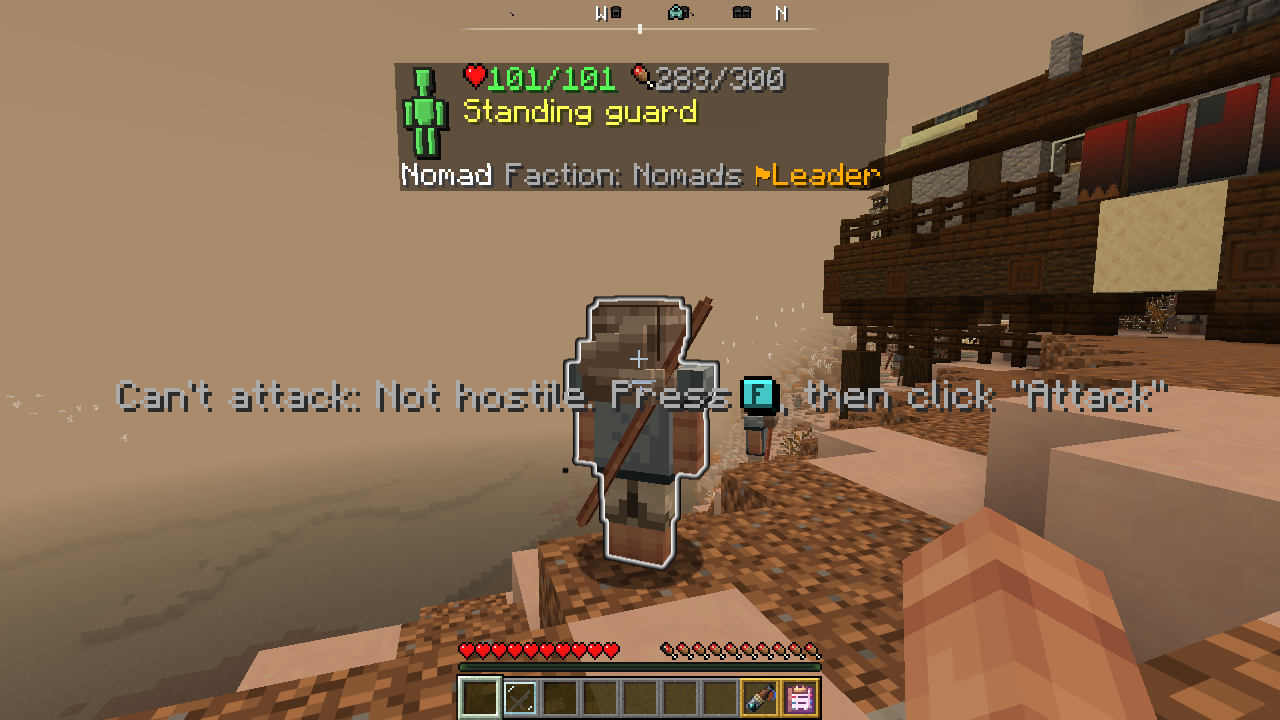
- Your own squad members
- People on the same side
- People who aren’t hostile to you (including neutral bystanders who are unconscious)
- Other people’s slaves
- Your squad’s own animals
The same applies to wild animals that aren’t hostile, and the action bar says who will turn on you if you attack, for example “attack it and the whole group will fight back”.
If you really mean to attack, press F to open their menu and click [Attack]. For the bounty and relations that follow from attacking people, see Crime and Law and Hostility.
Hitting back needs no confirmation: if the other person is attacking you, has hit you within the last 30 seconds, or someone in their squad has done either, left-click hits them straight away.
A brawl doesn’t keep flashing “Can’t attack”: if your blow falls on your own side or a bystander and an enemy is standing near where it lands, the blow goes to that enemy instead. Only if no enemy is nearby is the blow stopped, with the reason shown; the same message appears at most once every 3 seconds.
What weakens you
Link to the “What weakens you” section- Heavy armour: each piece of armour has its own attack penalty and damage multiplier. For example, Samurai Armour gives Attack −8 and damage ×0.85. See Armour.
- Backpacks: wearing a backpack lowers both Melee Attack and Melee Defence, −10 for a Large Backpack and −2 for a Small Backpack. See Backpacks.
- Malnourished, Weak limbs: attack damage is reduced; see Hunger.
- Lying on the ground: when your legs can’t be used and you can only crawl, left-click still strikes, but at half force, it can only hit the chest, stomach, and legs, and there are no big attacks, jump attacks, or crouching thrusts. With both arms unusable, you can’t strike from the ground at all. See Special Moves.
- Injured arms: if either arm is unusable, attack damage ×0.66; if your main hand (the right) is unusable, attack speed drops to about a third, and if the other hand is unusable, it halves. With both unusable you can only kick. For severed arms and prosthetics, see Crippling and Limb Loss.
- Not enough Strength: if the weapon’s Strength requirement is above your Strength, the attack interval gets longer, up to thirty percent slower; see Weapons.
- Long weapons indoors: your attack value is lowered and positive attack bonuses don’t count either; see Damage Types.
- Carrying someone: you can’t swing two-handed weapons, and the action bar says “Can’t use two-handed weapons while carrying someone”.
Staggering
Link to the “Staggering” sectionTaking a blow doesn’t make anyone pause: when you are cut, you can still strike, and so can the other side.
Only a heavy enough blow has a further effect. When a blow, after armour and Toughness are taken off, really does about 52 or more damage, the one hit staggers: for the next 1.5 seconds, walking and running are forty percent slower.
- While staggered you can still attack, block, and dodge; you just can’t move fast.
- Another heavy hit during a stagger starts the 1.5 seconds again; the slowdown doesn’t get worse with each hit.
- The higher your Toughness, the less of the same blow reaches you, and the harder you are to stagger.
- You and residents follow the same rule: you stagger too when you take a heavy hit. Beasts don’t stagger.
- A jump attack staggers more easily; about half the damage is enough. See Special Moves.
To make someone stagger, wait for full force before you strike, or use a big attack. Each blow from rapid clicking has only half force and rarely reaches the threshold.
How opponents fight you
Link to the “How opponents fight you” sectionResidents follow the same rules as you: the same attack interval, the same way of working out force, the same big attacks and reach.
- When someone cuts you, the base for a full-force blow is 25 points, multiplied by the skill gap (×0.1 to ×1.9), for at most 47.5 points; your armour and Toughness then reduce it.
- Being cut doesn’t knock you back.
- There is no protection of the “only one person can hit you at a time” kind. Surrounded by three people, you are cut by all three.
- Opponents use footwork: they only strike when their blade tip can reach you, lunge a step forward as they strike, step back to guard afterwards, then circle around you. If you have already backed out of their reach when they strike, the blow hits nothing.
- They watch how many people their big attack would catch. When you are the only one in front of them, they mostly strike one full-force blow per interval; when you and your squadmates are crowded inside their fan, they more often hold off until the attack bar is full and then sweep everyone at once.
- You can see their state. Badly wounded, missing limbs, bleeding, with a companion down, outnumbered, or seeing you close to falling, they get rash and strike faster and lighter. Healthy and with the numbers on their side, they are calmer and use more full-force blows and big attacks.
- While they raise their weapon to block, they don’t strike, but their attack bar keeps filling, so the first blow after they lower it may be a big attack.
After an opponent has held off for a while, the next blow is most likely a big attack. Don’t stand together with your squadmates then.
| Situation | Number | Notes |
|---|---|---|
| How much harder this world’s weapons hit than other things | 6× | Anything else counts as 1 |
| How heavy a full-force blow with maxed skills is | 50 points | Before the weapon itself and the target’s armour |
| How much skill changes your damage when you hit others | 0.55×–1.45× normal | 2.5% for each level of difference between your attack and their defence |
| How much skill changes damage when others hit you | 0.1×–1.9× normal | 5% for each level of difference |
| How heavy a blow against you is | 25 points | At most 47.5 points |
| Fastest you can strike | Half an attack interval | Only half force |
| How long to wait for full force | One attack interval | Waiting longer adds nothing |
| How long to wait for a big attack | One and a half attack intervals | The attack bar fills |
| What happens without enough Strength for your weapon | 1.5% slower for each missing level | Up to 30% slower at 20 or more levels short |
| How heavy a blow on an unconscious person is | 1.5× normal | Always lands on the chest |
| How far off your crosshair can be and still count | Within 8° | Still has to be within reach |
| How long after being hit you can hit back without it being a crime | 30 seconds | |
| How often the “Can’t attack” message appears | The same message once every 3 seconds | |
| How heavy a blow must be to make someone stagger | About 52 or more actually landing | A stagger slows walking and running by 40% for 1.5 seconds; a jump attack needs only about 26; beasts never stagger |
| How heavy a blow is when you strike from the ground | Half of normal | Only chest, stomach and legs can be hit |
| What happens when an arm can’t be used | Damage 0.66× normal | Main hand unusable: attack speed 0.33×; other hand unusable: 0.5× |
| What fighting with a backpack on does | Large −10, Medium −5, Small −2 | Lowers both Melee Attack and Melee Defence |
| Example: fighting in Samurai Armour | Attack −8, damage 0.85× normal |
Attack interval (time between full-force blows; skill and Dexterity at the same level, enough Strength, no other slowdowns):
| Weapon | Level 5 | Level 50 | Level 100 |
|---|---|---|---|
| Wakizashi | 0.55 seconds | 0.4 seconds | 0.3 seconds |
| Katana | 0.55 seconds | 0.45 seconds | 0.3 seconds |
| Jitte | 0.6 seconds | 0.45 seconds | 0.35 seconds |
| Naginata | 0.65 seconds | 0.5 seconds | 0.35 seconds |
| Desert Sabre | 0.7 seconds | 0.55 seconds | 0.4 seconds |
| Combat Cleaver | 0.7 seconds | 0.55 seconds | 0.4 seconds |
| Falling Sun, Plank | 0.9 seconds | 0.7 seconds | 0.5 seconds |
| Fragment Axe | 1 second | 0.8 seconds | 0.55 seconds |
Big attack angle and number of people (skill means the skill for that weapon class):
| Skill | Angle | Katanas | Sabres, Hackers | Blunt | Polearms | Heavy Weapons |
|---|---|---|---|---|---|---|
| Level 5 | About 50° | 1 (two cuts) | 2 | 1 | 2 | 3 |
| Level 20 | About 80° | 1 (two cuts) | 2 | 1 | 3 | 5 |
| Level 35 | About 105° | 1 (two cuts) | 3 | 2 | 3 | 6 |
| Level 50 | 135°, turning sweep | 2 | 3 | 2 | 4 | 8 |
| Level 60 | 210° | 2 | 4 | 3 | 5 | 9 |
| Level 70 | 285° | 2 | 4 | 3 | 5 | 10 |
| Level 80 and up | Full circle | 3 | 5 | 4 | 6 | 12 |
The number of people includes the one you are aiming at.
See also
Link to the “See also” sectionOfficial siteHow to joinWorld mapFAQ
DustMoon.net is not an official product of Mojang Studios or Microsoft, and is not approved or endorsed by them.
DustMoon is inspired by the world of Kenshi and is not affiliated with Lo-Fi Games.
© 2026 DustMoon.net