
Survival and the Body
A character gets hungry, bleeds, and loses arms and legs. Being beaten is not the same as dying: you go down on the ground first. This section explains the states the body can be in and how wounds are healed.
Three states of the body
Link to the “Three states of the body” section- Satiety: 0 to 300. It drops over time and is restored by eating. Go too hungry and you first weaken, then faint on a timer, but hunger alone does not kill.
- Seven body parts: head, chest, and stomach are the vitals; left arm, right arm, left leg, and right leg are the limbs. Each cell loses health separately and heals separately.
- Blood: the blood shared by the whole body, called Oil for a Skeleton. Ordinary cuts do not make you bleed; only a severed arm or leg does.
The hearts at the bottom of the screen show whichever of the four values head, chest, stomach, and blood has the lowest ratio. However badly the arms and legs are wounded, the hearts do not necessarily drop: serious limb wounds make it hard to move, but they do not make you go down.
Eating your fill does not restore blood, and logging off and on again does not heal anything. Wounds heal in only three ways: natural recovery, bandaging, and resting in a bed.
Going down is not death
Link to the “Going down is not death” section- Going down: when a vital is beaten to 0 or below, or blood runs out, you pass out. Going too hungry, a worsening wound, and falling from a height also bring you down.
- Lying on the ground: you wait to wake by yourself, wait for someone to bandage you, or are taken away by a passer-by — some people help you, and some search you or carry you off to sell.
- Death: when a vital or blood keeps dropping and reaches the “negative of its maximum”, you really die. A Greenlander’s head has a maximum of 100 and has to drop to −100.
There is still a stretch of time between going down and dying, and bandaging can be done during it.
Where to see your own state
Link to the “Where to see your own state” section- Inventory (E): the 2×2 cells to the right of the character used to be the crafting grid and are now the prosthetic slots. The cell to the right of the arrow is called “Body status”; move the cursor over it to see blood, the seven parts, and where you are bleeding, with the matter most in need of attention “Now” written at the top.
- Scoreboard on the side: blood, the seven parts, and satiety are listed here row by row.
- Looking at others: aim your crosshair at them or look through the scope. The first line of the nameplate is the numbers after the heart and drumstick icons.
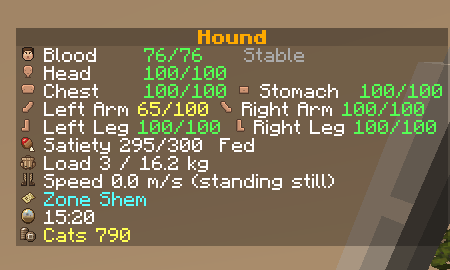
For the layout of the scoreboard and nameplates, see HUD, Messages and Scoreboard and Nameplates and Skeleton Eye Scope.
Which page to read when you see these words
Link to the “Which page to read when you see these words” section| Words you see | What it is | Read this page |
|---|---|---|
| Hungry/Malnourished/Starving | Satiety has dropped below 250, 200, or 90 | Hunger |
| No need to eat | Skeletons do not eat | Hunger |
| Weak limbs | You ate a roasted severed limb | Eating and Food |
| Bleeding | The wound of a severed limb has not been stopped | Wounds, Blood and Recovery |
| Wounds worsening | Unbandaged cut damage is getting more and more serious | First Aid |
| Unconscious | Knocked out, fainted from hunger, or passed out from blood loss | Knockout |
| Deep coma: Needs bandaging | The vitals are too badly wounded to wake without a bandage | Knockout |
| Can only crawl | Both legs are unusable | Crippling and Limb Loss |
| Acid rain burning | You are standing in acid rain | Environmental Hazards |
The three things beginners trip over most
Link to the “The three things beginners trip over most” section- Setting out without food. Once satiety falls below 90 you faint once every two minutes without fail, and being unconscious in the wilds is more dangerous than the hunger itself. Carry a few portions of Dried Meat or rations and you eat them yourself when hungry. For where to get food, see Getting Food.
- Leaving cut damage alone. Unbandaged cut damage that builds up starts to worsen and in the end puts you in a deep coma. Bandage first after a fight, then move on.
- Going down outside town. While you lie on the ground, passers-by may come to help you, or may search you or carry you off.
Skeletons are the exception
Link to the “Skeletons are the exception” sectionA Skeleton’s whole body is machinery: no need to eat, blood called Oil, bleeding very slowly and healing very quickly. First aid kits do nothing for Skeletons, who need a Skeleton Repair Kit. The wear left by blows cannot be restored in an ordinary bed and is repaired only in a Skeleton Repair Bed. Skeletons are also not wounded by acid rain, acid ground, acid water, or fire. For the race itself, see Skeleton.
Pages in this section
Link to the “Pages in this section” section- Hunger: how fast satiety drops and what going too hungry does.
- Eating and Food: what you can eat, how much one bite restores, and whether severed limbs can be eaten.
- Getting Food: buying, cooking, hunting, farming, and looting, and the fastest way to start.
- Drinking and Blackout: three bottles in a row bring a blackout, and you wake somewhere else.
- Body Parts and Health: how the seven parts lose health and how hearts are worked out.
- Wounds, Blood and Recovery: which wounds heal by themselves and which worsen.
- First Aid: how to use a first aid kit and what gets bandaged first.
- Sleep and Rest: a bed can be used at any hour, and can also set a respawn point.
- Knockout: what you can do after going down and how long it takes to wake.
- Who Finds You When You Fall: who reaches you first decides the outcome.
- Calling for Help: getting nearby travellers and your squad to come when you are down and nobody is coming.
- Crippling and Limb Loss: a crippled arm or leg can still be healed; a severed one does not grow back.
- Prosthetics, Wear and Repair Beds: how a severed limb is replaced.
- Death and Respawn: what you lose on death and where you wake.
- Environmental Hazards: acid rain, gas, beams of light, and fire.
Not in this section: for weapon damage and armour see Combat; for being captured, jailed, or enslaved see Crime and Law; for building the Cooking Stove, beds, and repair beds see Outposts, Building and Crafting; for the prices of food and medical supplies see Food and Drink and Medical Supplies; for squad members bandaging you and eating what is in your backpack see Squad and Companions.
With the Greenlander as 1: the higher the appetite, the sooner you get hungry; the higher the healing, the faster you recover; the lower the bleeding, the slower you bleed.
| Race | How fast it gets hungry | How fast wounds heal | How fast it bleeds | Maximum per body part |
|---|---|---|---|---|
| Greenlander | 1.0 | 1.0 | 1.0 | 100 |
| Scorchlander | 0.9 | 1.1 | 0.9 | 100 |
| Shek | 1.25 | 0.8 | 0.9 | 125 |
| Hive Prince | 0.5 | 1.0 | 0.3 | 80 |
| Hive Worker Drone | 0.5 | 1.0 | 0.3 | 75 (head 125) |
| Hive Soldier Drone | 0.6 | 1.0 | 0.3 | 100 (head 200) |
| Skeleton | 0 (no need to eat) | 2.0 | 0.1 | 200 |
| Situation | Number | Notes |
|---|---|---|
| How much satiety you can have | Up to 300 (down to 0) | Being full doesn’t restore health |
| When you pass out | A vital at 0 or below, or blood at 0 or below | A limb at 0 or below is crippled; it doesn’t make you pass out |
| When you die | A vital or blood reaches the negative of its maximum | Example: a head with a maximum of 100 reaches −100 |
| How wounds heal | Natural recovery, bandaging, lying in a bed | Logging off doesn’t heal you |
For the races of other origins, see Race Comparison.
See also
Link to the “See also” sectionOfficial siteHow to joinWorld mapFAQ
DustMoon.net is not an official product of Mojang Studios or Microsoft, and is not approved or endorsed by them.
DustMoon is inspired by the world of Kenshi and is not affiliated with Lo-Fi Games.
© 2026 DustMoon.net