
Shops
Every shop has a shopkeeper, and trading means going to him in person. The shop’s cash box is limited, and the goods on the shelves sell out. Buy one item and there is one fewer on the shelf; sell too much in one go and the shop can’t pay. This page covers how to do business with a shopkeeper. For which shops a town has and where they are, see Town Facilities.
Opening a shop
Link to the “Opening a shop” sectionInteract with the shopkeeper and pick [Trade] to get the trade window. The title shows the shopkeeper and the type of shop, and there are only seven types: Bar, Weapon Shop, Armour Shop, General Store, Food Store, Black Market, and Caravan. A caravan leader met on the road can be traded with directly too.
To trade you have to stay with the shopkeeper. If he falls asleep, is knocked out, dies, or is gone, or if you move more than about 7 blocks from him, the trade is broken off. The screen gives the reason, for example “Unable to trade: X is asleep”, or that you are too far from him. For cases where a shop won’t deal with you, such as being hostile to you or the Holy Nation not serving Skeletons, see Town Facilities.
The top half of the window is the shelves. Click a slot to buy one item. The first line of the description is the price, and that is the figure taken from your Money Pouch. Bolts are bought a whole bundle at a time.
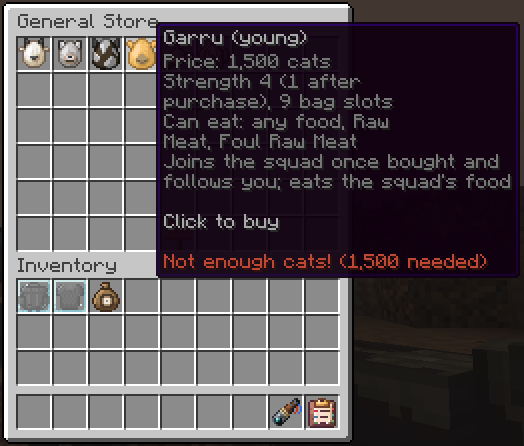
- The number on a slot is the stock. Above 99 it only shows 99, and the description adds “N on the shelf”.
- A sold-out slot is shown as a red no-entry sign, and the description reads “Sold out” with the restock time.
- Each weapon and each piece of armour has a quality of its own. Buy one, and the next one put on the shelf isn’t necessarily as good. For quality, see Quality and Grades.
- Too few cats gives “Not enough cats! (N needed)”, and no room in your inventory gives “Inventory full!” Neither takes any money.
- Shops with many goods are split into pages of 45 slots, with [Previous Page] and [Next Page] in the two corners of the bottom row. Research Blueprints come last.
In a town that has just been attacked, the shelves carry an extra line, “+N% after the siege, back to normal in about M min”; see Prices and Trading.
With the window open, hover over things in your own inventory. For something that can be sold, the first line of the description reads “Sells for: N cats”, and for a stack it gives the price each and for the whole pile. Something that can’t be sold is shown as a red no-entry sign with [Cannot be sold (reason)]. For the full list of reasons, see Unsellable and Not-for-sale Items.
When you are sure, Shift + left-click the slot, and the whole stack is sold together.
The notice board in the middle of the bottom row, [Sell Items], shows this shop’s buying rules, “Shop funds: N cats”, how many you have, and the time of the next restock.
The rules in one sentence: trade goods are bought at the full local market price; weapons, armour, clothing, and crossbows at only a quarter; other things at half; and stolen goods at half again. So buying something and selling it back at the same shop always loses money, except with trade goods. For the details of pricing, see Prices and Trading.
The shop’s cats and Shop Debt
Link to the “The shop’s cats and Shop Debt” sectionA shop’s money is limited. What you pay him for purchases goes into his cash box, and what you sell him is paid out of the cash box. Each time a town shop restocks, the cash box is topped up to a quarter of the total value of the goods on the shelves, about 25,000 cats at most. It is only ever topped up; anything above that isn’t taken away.
When the money runs short, the shop owes you. A town shop still buys when its cash box is empty: it takes the whole stack, pays what it can, and the difference is counted as cats this shop owes you. Before you sell, the item’s description warns you: “The shop is short on cats and will owe N cats”. Once the shop owes you money, the bottom left of the trade window has an extra slot, [Shop Debt].
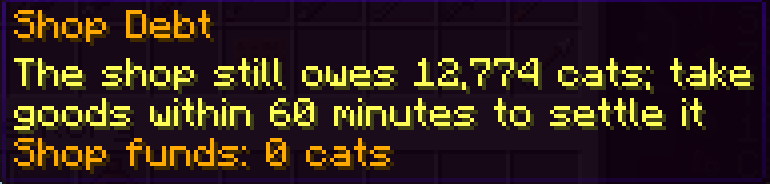
- There is only one debt per person per shop, kept for 60 real minutes. If the shop falls short again on another sale, the amount is added and the time starts over.
- Buying at this shop during that time uses the debt first, and only the remainder comes out of your cats: “N cats settled from the shop’s debt; it still owes N cats”.
- If it hasn’t been used up when the time runs out, the debt lapses and no cats are refunded: “The shop’s debt has lapsed: no goods were taken within 60 minutes”.
A caravan that is short of money doesn’t owe you, and mostly has no buying funds at all. A caravan can only buy your goods with the money travellers have paid it for earlier purchases. If nobody has bought from it, it can’t buy a single item: “Unable to sell: the caravan has no buying funds. Buy from it first.” When the money covers only a few items, the description tells you how many the shop can afford.
What you sell to a shop goes on that shop’s shelves, and until the next restock anyone can buy it.
- In the same trade (before closing the window): buy it back at the price you sold it for.
- After closing the window: at the shop’s current selling price, and never less than what he paid you.
- Gone after a restock: “Unable to buy back: no longer in the shop (sold on after a restock)”.
A few things are stocked by no shop. The shop still buys them and pays, but they don’t go on the shelf, and they can only be bought back within the same trade. Buying back at a regular shop doesn’t clear the stolen mark; for cleaning stolen goods, see Black Market and Fencing.
Opening hours and restocking
Link to the “Opening hours and restocking” sectionGeneral shops close at midnight (0:00) game time and open at 6 in the morning. Farm-type shops close at 10 at night and open at 7 in the morning. Bars, the Skeletons’ robotics workshops, and Hive traders never close. Go to a shopkeeper after closing and all you get is “X is closed. Opens at 6 AM.”
If you are still in the shop at closing time, the shopkeeper and shop guards ask you to leave within 60 seconds. If you still don’t go after that, at night it is treated as trespassing. See Opening Hours and Private Buildings and Trespassing.
Restocking runs on each shop’s own cycle, shown on the notice board and on sold-out slots, such as “Restock time: today 18:00”, “Restock time: next day 06:00”, or “Restock time: 2 days later, 06:00”.
This is the in-game clock, the same one as the time on the scoreboard: one game hour is 50 real seconds, and one game day is 20 real minutes. Most shops restock once per game day, which is about 20 real minutes. A few are as quick as 5 minutes, the slow ones take over an hour, and a very few hardly ever restock.
If a named shopkeeper dies or is taken away, that shop no longer restocks.
Repairing gear
Link to the “Repairing gear” sectionIn the trade window of a Weapon Shop or Armour Shop, there is an extra anvil beside the notice board, [Repair Held Item]. A Weapon Shop repairs weapons and crossbows, and an Armour Shop repairs armour and clothing.
Hold the item to be repaired in your hand before opening the shop, and the anvil’s description shows its durability and “Cost: N cats”. The fee = item value × 25% × the proportion worn, with a minimum of 50 cats. A Katana worn all the way down costs about 3,000 cats. After the repair, durability is back to full and the penalties for being broken go with it. For wear itself, see Armour and Weapons.
What else shops sell
Link to the “What else shops sell” section- Research Blueprints: last on the shelves, and learned the moment you buy them. See Blueprints, Recipes and Research.
- A bed: the Barman’s [Rent a Bed]. See Taverns and Lodging.
- Animals: with a shopkeeper who sells animals, the trade window has an extra slot, [Animals]. See Pets and Pack Beasts.
- Slaves: a slaver’s [Buy slaves]. See Captives and Cages.
| Situation | Number | Notes |
|---|---|---|
| How close you must be to trade | About 7 blocks | Walking away breaks it off |
| When general shops close | 0:00–6:00 in-game | |
| When farm-type shops close | 22:00–7:00 in-game | |
| Which shops never close | Bars, the Skeletons’ robotics workshops, Hive traders | |
| How long you have to leave after closing | 60 seconds | Staying on counts as trespassing at night (23:00–7:00) |
| How game time compares to real time | 1 hour is 50 real seconds; 1 day is 20 real minutes | Restock times follow this |
| How often shops restock | Mostly every 24 game hours (about 20 real minutes) | Some every 6, 12, 48 or 72 game hours |
| How much cash a shop gets back | A quarter of the total shelf value | About 25,000 at most; only topped up, never taken away |
| How long a shop’s debt to you is kept | 60 real minutes | Starts over if the shop falls short again; lapses with no refund |
| How many slots one shelf page has | 45 | |
| Most stock a slot shows | 1–99 | Anything more is given in the description |
| What shops pay you | Trade goods at the selling price; weapons, armour, clothing, crossbows a quarter; everything else half | Stolen goods half again |
| What a repair costs | Item value × 25% × share worn | 50 cats minimum |
See also
Link to the “See also” sectionOfficial siteHow to joinWorld mapFAQ
DustMoon.net is not an official product of Mojang Studios or Microsoft, and is not approved or endorsed by them.
DustMoon is inspired by the world of Kenshi and is not affiliated with Lo-Fi Games.
© 2026 DustMoon.net