
How Residents Earn and Spend
While you aren’t there, the people in town go on with their lives: residents draw wages, pay for meals and lodging, and sell what they have robbed, and caravans carry goods from town to town. The shelves you see, the cats a shop has on hand, and the prices on the map are all the result of that trade.
All hours below are on the in-game clock: a day is about 20 real minutes, and an hour about 50 seconds.
Who is doing what
Link to the “Who is doing what” sectionThe activity line on a nameplate says what the person is doing right now: “Going to eat”, “Shopping”, “Minding the shop”, “Drinking”; for those at work, “Mining”, “Farming”, “Drawing water”; and for a caravan on the road, “Hauling goods to X”.
- Civilians go out round the shops from 8 to 17 during the day, stay home the rest of the time, and go to bed at 9 at night.
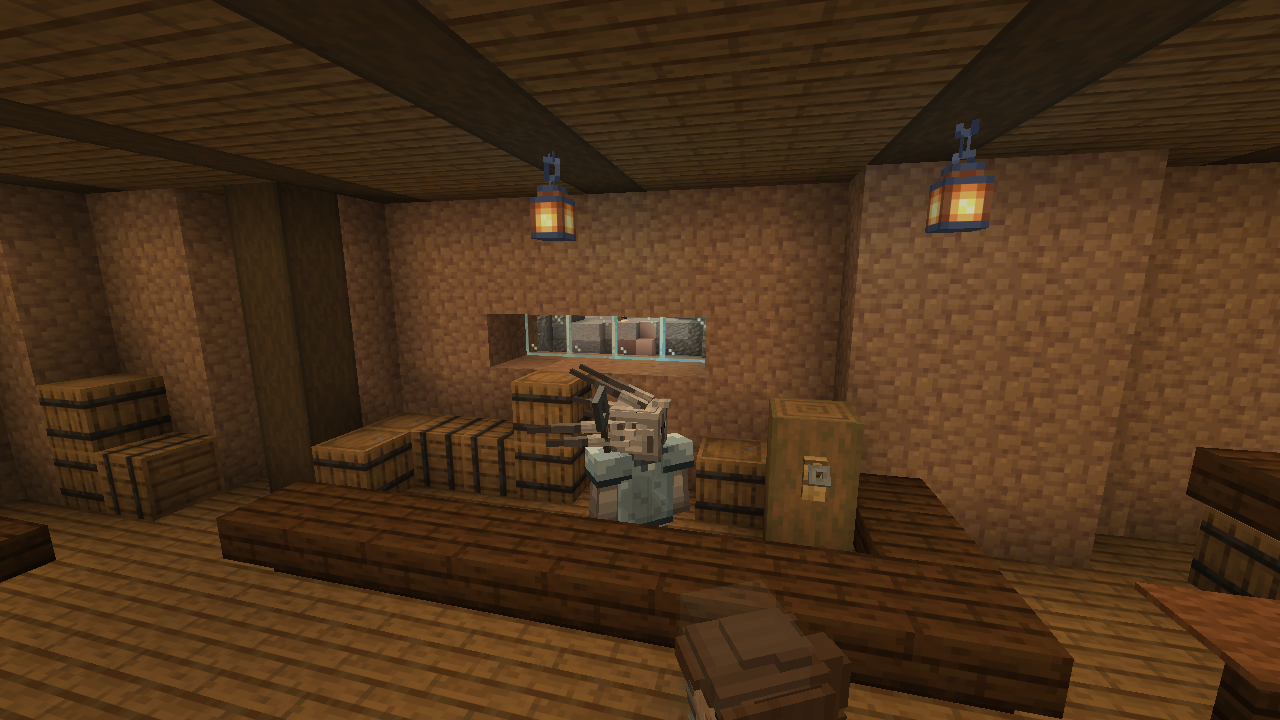
- Shopkeepers stay at the counter. Bars never close, and the Barman stands behind the bar in the middle of the night too.
- Workers work shifts at the mines and fields, some of them at night. The raw materials they produce are sold to the town shops that buy such goods.
- Drinkers sit in the bar and buy when they feel like it. Guards stand watch and patrol the town, and don’t go shopping.
By day the streets are busy. In the evening some people walk out of town, at night only the original occupants remain, and at dawn the others come back. For the daily routine in detail, see Opening Hours and Private Buildings.
Where the money comes from and where it goes
Link to the “Where the money comes from and where it goes” sectionPeople with a daily wage are paid once a day at 6 in the morning. Most of it is saved as living money (up to 5,000 cats), which can’t be looted or robbed. Only the small part moved onto the person is change that can be looted or robbed. A Citizen has a daily wage of 1,300 and carries a little over a hundred at most. People in shackles or being held draw no wage.
So robbing a passer-by doesn’t get you his savings. Knocking down a shopkeeper is the same: the shop’s takings are kept in the shop, and that is the “Shop funds” in the trade window. For how much can be looted from a person, see Cats and Money Pouch.
Spending is real spending. Meals, purchases, and lodging are all paid for at the shelf price: one item fewer on the shelf, one more payment for the shop. Stand close enough and you can see it:
- Red text floats over the person paying, “−N cats”, and green text over the shopkeeper being paid, “+N cats” (within 24 blocks).
- Within 8 blocks, when you can see the person paying, chat has an extra line: who paid whom how much, what was bought, and why. The reasons are things like being hungry, stocking up on food, buying medicine for wounds, lacking weapons or armour, buying a prosthetic, or needing to sleep. Not being able to pay is reported too, at most once a minute for the same person.
- The nameplate of the person paying shows “Eating (−N cats)” for three seconds.
Lodging is free for the same faction or allies, and the same person pays only once a night at the same place. If it is too noisy for you, switch off [Payment Amounts] in [Preferences].
What they buy
Link to the “What they buy” sectionEach kind of person has a shopping list, and each line is one category of thing (one serving of food, one of drink, and so on):
- Citizen: one serving of food and one of drink (in some towns, only some Citizens buy drink).
- Holy Citizen: one serving of food; very few buy drink.
- Bounty hunter: medical supplies (first aid kits, Splint Kits), one serving of food, and one of drink.
- Caravan leader: twelve servings of food at a time, sometimes with tools, drink, and medical kits as well.
- People with no list: food, drink, and medical kits each find some buyers.
Before going round the shops they set aside the money for two meals. In each category they buy only the few items on the list each day, and only buy another round after moving to another town or after 7 in the morning.
Most of what they buy is eaten, drunk, or used for bandaging on the spot, and the rest goes into the bag. People who have lost an arm or a leg go and buy a prosthetic themselves (people of the Holy Nation don’t); see Prosthetics, Wear and Repair Beds.
Residents don’t buy a slot empty. When about a quarter is left on the shelf (at least 2 items), residents stop, and the rest is left for travellers. When food or drink falls below half, the shop pays every hour to restock fully from elsewhere.
Residents sell things too
Link to the “Residents sell things too” sectionThose who loot the downed (bandits and their like) take what they have robbed into town to sell after winning a fight. They only go to shops that aren’t hostile and are open, and choose the one offering the highest price, which is the same price you would get for the same item.
A squad makes at most one selling trip per game day, with at most 3 stacks per person. What they are wearing and bound gear aren’t sold, and nothing is sold back to the owner’s faction. The shop uses only the comfortable half of its money to buy from them, so the cash box isn’t emptied.
What they sell goes on that shop’s shelves, where anyone can buy it. The things robbed from you are quite likely in a shop in some nearby town; for buying back, see Shops.
Caravans
Link to the “Caravans” sectionA caravan leader travels between towns with guards and pack beasts. On reaching a town, the leader and guards first go to the shops to buy what they need from their own lists, and then set up a stall: selling first, buying after.
- Selling: only to shops whose goods list has the item, taking half the local shelf price, and only when it earns at least a tenth more. Anything still unsold after three stops is sold at a loss.
- Buying: only what a shop has in surplus, and only in towns where the local price is no higher than the baseline price. At most half the money carried is spent at one stop, and at most 120 items are loaded.
Buying where it is cheap and selling where it is dear is the same idea as your own trade route; see Prices and Trading. You can trade with the leader directly on the road.
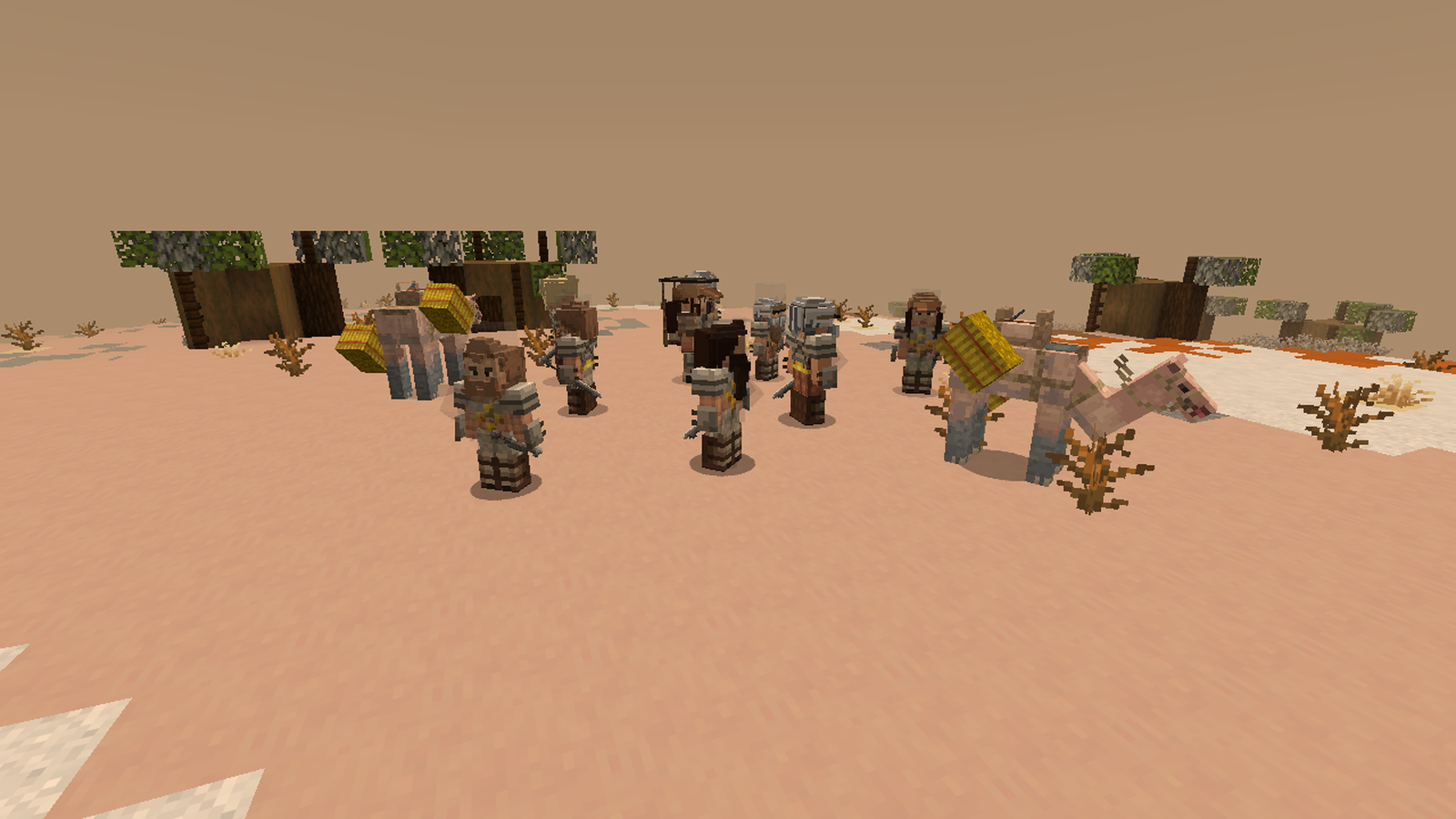
When a caravan is beaten by another squad (bandits and the like), half its goods and half its money are taken. When it loses to wild beasts, everything is left untouched.
If you knock down the whole caravan yourself, half of each slot of goods is packed into the pack beast’s bags (or scattered on the ground if there is no pack beast). All of it is stolen goods, and you can only get it once per fight. For selling it, see Black Market and Fencing.
When there is nothing to eat
Link to the “When there is nothing to eat” sectionSomeone who can’t pay doesn’t collapse from hunger on the spot. Those with an income who are short for the moment can have two free mouthfuls provided by the town each game day. For people who draw no pay anyway, such as those in barracks and worker drones, the town provides meals as usual.
When someone is truly hungry and can’t buy food, he asks a passing traveller “Got any food to spare?” Right-click him, and the talk menu has extra options to give him a particular food, or “Give 200 cats”.
In any one town, only the hungriest person asks at a time. The same traveller is only asked once in a little under two real minutes.
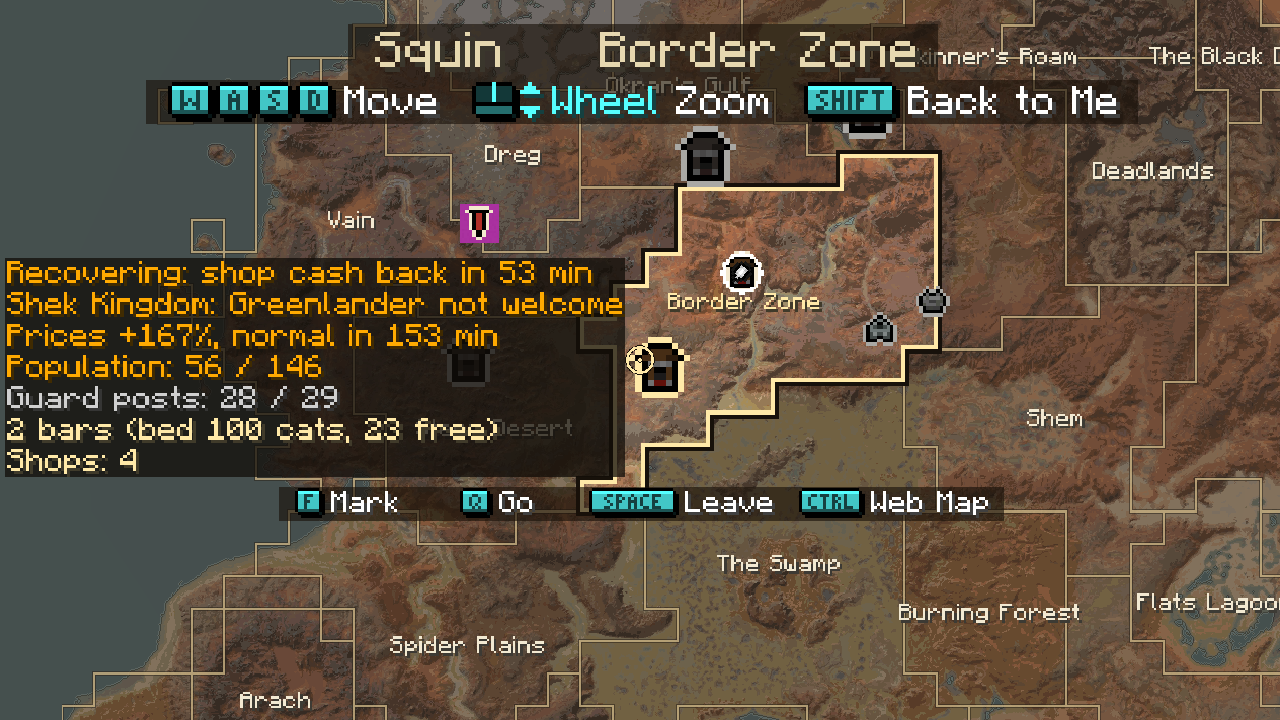
When too many people in a town have gone without a meal in the last 60 minutes, the World Map (for towns you have visited) has an extra line, “Food is getting tight (about N an hour go without)”, and when it is worse, “Food is short” in red. People who have gone without a meal are more willing to come and buy at a food counter nearby; see Visitors, Inn and Shop Counter.
After a siege
Link to the “After a siege” sectionWhile a town is besieged, its shops stop bringing in goods. Shops the attackers break into are sacked: the cash box goes to the attackers’ faction, and the goods are shared into the attackers’ bags and carried off. After the withdrawal, things recover in this order:
- Shops whose goods were robbed don’t restock until 20 minutes after the withdrawal.
- Shops whose cash boxes were emptied get no cash for 60 minutes after the withdrawal.
- Shopkeepers and guards are replaced first, by the usual rules. Residents only start to return about 90 minutes after the withdrawal and take another 90 minutes to be back in full, and those who return are new faces.
Prices rise as well. How much depends on the dead and wounded, those taken captive, shops sacked, shopkeepers lost, and buildings burned: a small clash raises prices by a tenth, a town wholly destroyed raises them to three times, and they return to normal within 30 to 180 minutes. If food was robbed, food rises by half as much again.
Buying prices rise with them, paid in cash only, and things bought in the same town don’t count; for details, see Prices and Trading. For the siege itself, see Sieges and Aftermath.
What to do
Link to the “What to do” section- If your things have been robbed, go through the shelves of shops in nearby towns.
- To sell food, pick a town marked “Food is short” on the map.
- Don’t buy in a town that has just been through a battle; instead, bring goods from elsewhere and sell them there.
- What you get from robbing a caravan is stolen goods, so decide first where you will sell it.
| Situation | Number | Notes |
|---|---|---|
| When residents get their daily wage | 6 every morning | Saved as living money that can’t be looted, up to 5,000 cats |
| How much change people with a daily wage carry | Up to about a tenth of the wage | At most 1,000 cats; e.g. a Citizen earning 1,300 carries up to 130 |
| How far away you can see paying and being paid | 24 blocks | Red for paying, green for being paid |
| How far away the payment chat line reaches | 8 blocks | You also have to see the person paying |
| How often the “can’t afford it” line appears | At most once a minute for the same person | |
| How much meal money residents keep before shopping | 2 meals | By the cheapest meal in that town |
| When residents go shopping again | 7 in the morning, or on moving to another town | |
| How low a shop’s stock gets before residents stop buying | A quarter of the slot’s standard amount, at least 2 | The standard is about 8 for most goods |
| When a shop restocks food and drink on its own | When below half it’s filled up | Once an hour, spending at most half the shop’s money |
| How often residents go to sell things | 1 trip per squad per game day, 3 stacks each | No bound gear, and nothing sold back to its owner |
| What caravans sell for | Half the local shelf price | Only if they make at least a tenth; after 3 stops unsold they take the loss |
| Most a caravan spends at one stop | Half the money it carries | At most 120 items loaded |
| What knocking down a caravan gets you | Half of each slot | All stolen goods; only once per fight |
| How much food a town hands out | 2 mouthfuls per game day | Only for those with an income who are short for now |
| How often the same traveller is asked for food | About once every 2 game hours | About 1 minute 40 seconds in real time |
| When the map shows “food is getting tight” | 5% or more couldn’t buy food in the last 60 minutes (at least 6 people) | Gold text on the map |
| When the map shows “food is short” | 15% or more (at least 10 people) | Red text on the map |
| How soon robbed shops restock again | 20 minutes after the enemy withdraws | |
| How soon shops with emptied cash boxes get cash again | 60 minutes after the enemy withdraws | |
| When residents come back to town | Starting about 90 minutes after the withdrawal, all back within another 90 | Shopkeepers and guards are replaced first |
| How much prices rise after a siege | Up 10%–200% | Back to normal over 30–180 minutes; a further 1.5× if food was robbed |
| Most extra a shop pays you during a rise | 5,000 cats per shop per rise | Cash only |
See also
Link to the “See also” sectionOfficial siteHow to joinWorld mapFAQ
DustMoon.net is not an official product of Mojang Studios or Microsoft, and is not approved or endorsed by them.
DustMoon is inspired by the world of Kenshi and is not affiliated with Lo-Fi Games.
© 2026 DustMoon.net