
Sandstorm
You aren’t hurt when a sandstorm blows. The trouble is everything else: in the blowing sand you can’t see far, your blade swings without force, and the bolts you shoot are pushed off course. Walking with the wind is faster, and walking into it is slower. A sandstorm shows up in the forecast ahead of time, so you can go around it, and you can also put it to use.
Where they blow
Link to the “Where they blow” section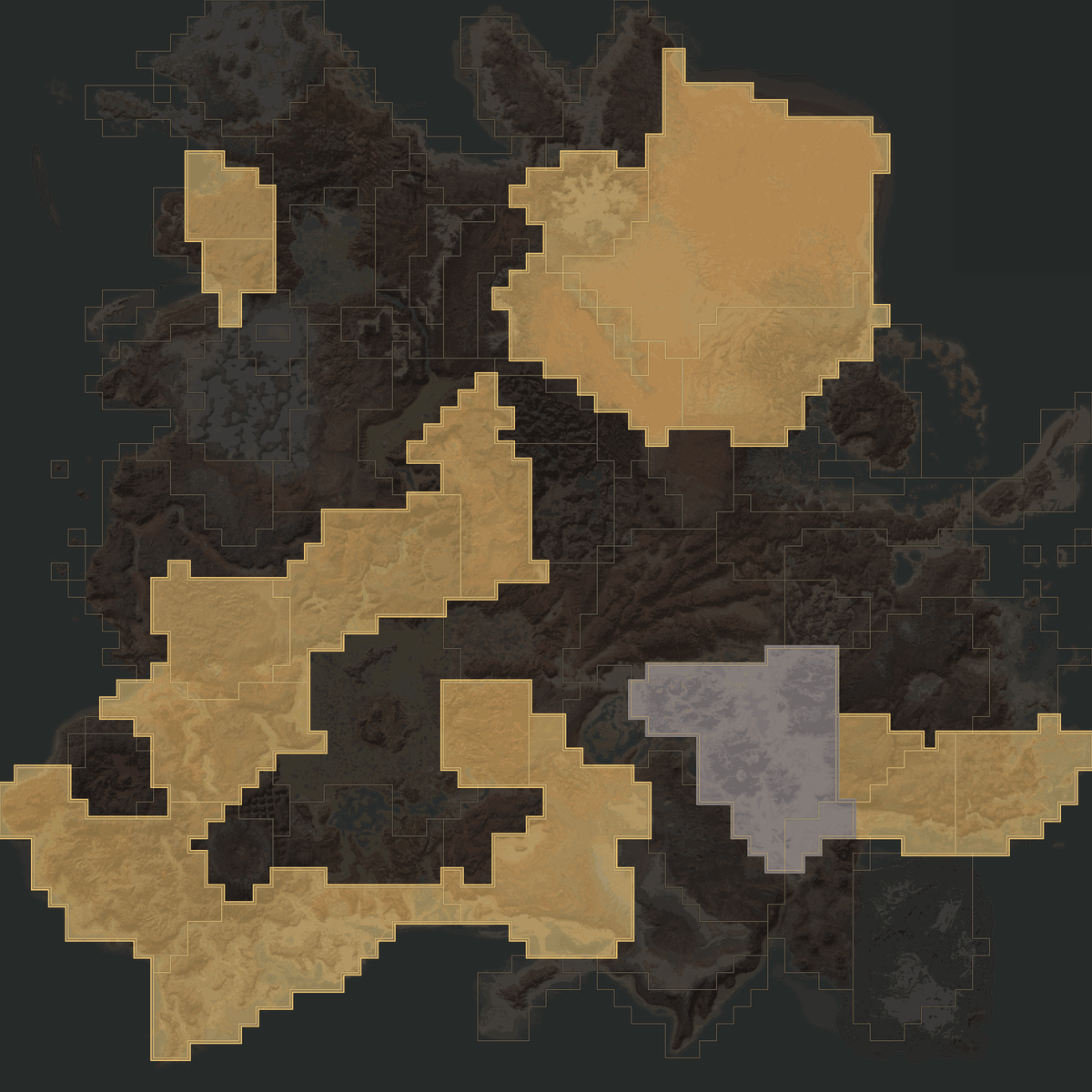
On the map, yellow marks the 18 regions where sandstorms blow, and grey marks Stobe’s Gamble and Sniper Valley, where ash storms blow.
- Northwest: Purple Sands, the Shrieking Forest (Northwest)
- North: Bast, Skinner’s Roam, Skimsands, Spine Canyon (North)
- East: the Great Desert, Heng (East)
- West and Southwest: Border Zone, Stenn Desert, Spider Plains, Burning Forest, Shun, the Hook (West and Southwest)
- South and Southeast: Bonefields, the Crags, the Pits, the Pits East; ash storms in Stobe’s Gamble and Sniper Valley (South and Southeast)
An ash storm is the same thing, except that the sand is ash and the wind sounds lower and duller. The name that is easy to misread is the Ashlands: no ash storms blow there. The trouble there is drifting gas clouds; see Gas and Beams of Light.
When they blow
Link to the “When they blow” sectionA sandstorm only blows once every few days. When it does, it lasts a whole game day: it starts at 06:00 on the scoreboard clock and doesn’t stop until 06:00 the next day, 20 minutes of real time. Sometimes one blows for two days in a row.
The blowing sand comes in patches, each about 512 blocks square. Within the same sandstorm region, one patch can be blowing while the patch next to it has no sand in the air. If you are caught in it you have two options: go around, or wait for it to pass.
Forecast. After the clock, the scoreboard shows which way the wind is blowing, and you can see this both before and after the sand rises. Wind strength comes in only three levels: not much wind, a fair wind, and wind too strong to stand steady in. When a sandstorm is really blowing, it is always the strongest of the three. The scoreboard describes the patch you are standing on, so look again once you have walked some way.
You can see it and hear it. While a sandstorm is blowing, the weather on the full scoreboard reads something like “dust storm (blowing northeast)”, and the compact one shows a sandstorm icon.
The moment you step into a storm area, you hear a rush of wind (subtitle “Sandstorm howls”; for an ash storm, “Ash storm howls”). After that the sound of the wind keeps coming from upwind, and every few seconds you hear a burst of sand hitting you. Turn around and you can tell by ear which way the wind is blowing.
What happens in a storm
Link to the “What happens in a storm” sectionThe things below only happen out in the open, meaning anywhere with no block at all above your head. Under a roof edge or under a tree, none of them happen.
You can’t see far. Someone standing in the open in blowing sand has to be closer before they notice anyone else, at only about two-thirds of the usual distance. What matters is where the one doing the looking stands: if the guards are standing in the sand, it is easier for you to creep up on them. The reverse holds too: if your squad members are standing in the wind, they notice enemies later.
If the one looking is wearing gear that blocks sand, the higher the protection, the smaller the effect. People under a roof edge, Skeletons, and beasts aren’t affected at all. So a sandstorm is a good time for sneaking and stealing; see Stealth and Disguise.
Your blade swings without force. Residents, enemies, and your squad members standing in the open in blowing sand deal only about 65% of their melee damage. For anyone wearing sandstorm protection, the higher the protection, the closer their blows are to normal. Skeletons and beasts aren’t affected. Damage dealt with a crossbow is not reduced.
Crossbows don’t shoot straight. Two things happen.
First, accuracy gets worse. Anyone who fires a crossbow while standing in the open in blowing sand, you included, has only about 65% of their accuracy. Anyone wearing sandstorm protection loses less. Skeletons aren’t affected.
Second, the wind pushes bolts off course. As soon as a bolt you shoot leaves the string it is pushed downwind, and the stronger the wind, the further it drifts. Within the same wind every shot drifts by the same amount, so after a few shots you can work out how much to lead. At the moment a bolt is pushed off course you hear a short whistle of wind (subtitle “Bolt drifts in the wind”), which sounds only once in any 8 seconds. For how to use a crossbow, see Crossbows.
Fast downwind, slow upwind. When you walk in the open in blowing sand: going with the wind (within about 70 degrees of the wind’s direction) makes you faster and gives you Speed; going into the wind gives you Slowness II; going across it or standing still gives you Slowness I. When you change direction, the effect changes within two seconds. Step under shelter or leave the storm area and these effects disappear at once.
If the scoreboard says “blowing northeast”, then walking north-east is going with the wind. This rule applies to Skeletons as well, and no gear blocks it.
Other things.
- Gathering with a Gathering Pickaxe is slower in a storm, and a line of pale text appears on the action bar: “Gathering is slower in a dust storm”. See Gathering Pick.
- The background music stops while the sand is blowing hard and carries on once the wind stops. See Sound and Music.
- People whose gear can’t keep the sand out raise their left hand to shield their eyes. Watch whether someone is shielding their eyes and you know whether what they are wearing is enough.
- In Roadside Conflicts, the ambushing side uses a sandstorm to creep within a dozen or so blocks before showing itself.
How to deal with it
Link to the “How to deal with it” sectionFind shelter. The cheapest way: a roof edge, a porch, under a tree. With a block above your head, none of the things in the whole section above happen.
Wear the right thing. Blocking sand depends almost entirely on the one item on your head. If you wear it yourself, your crossbow shoots straighter. If a squad member wears it, they see further and swing with more force. How fast you move with or against the wind is the same whatever you wear.
| Sandstorm protection | Headgear |
|---|---|
| 100% | Fog Mask, Mask Type III, Swamp Ninja Mask, Square Goggles, Ashlander Stormgoggles, Samurai Helmet |
| 75% | Basket Hat, Police Helmet |
| 70% | Tagelmust, Turban, Dyed Turban, Blackened Chainmail Tagelmust, Rusty Chainmail Tagelmust |
| 60% | Crab Helmet |
| 50% | Ashland Hat |
| 40% | Ninja Mask |
| 20%–25% | Armoured Hood (25%), Karuta Zukin, Kusari Zukin |
In the body slot, only Swamp Ninja Rags give anything, at 20%. For a comparison of all protective gear, see Weather.
Wait, or go around. A storm is only 20 minutes, and it isn’t too late to set off once it has passed. If you really have to travel, pick a downwind direction as far as you can.
Put it to use. If you want to sneak in, steal, or shake off pursuers, a storm day is the best time. Just remember that Skeletons and beasts on the other side aren’t affected by the blowing sand.
| Situation | Number | Notes |
|---|---|---|
| Which regions get storms | 18 regions get sandstorms, 2 get ash storms | Ash storms: Stobe’s Gamble, Sniper Valley |
| How big one patch of blowing sand is | About 512 blocks square | Each patch blows on its own |
| How long a storm lasts | 1 game day (20 minutes of real time) | Starts at 06:00, stops at 06:00 the next day |
| How far ahead the weather forecast goes | The next 64 game days | About 21 hours of real time |
| How the wind direction changes | It differs about every 1,024 blocks, turning gradually in between | Turns a little at 06:00 each game day, and comes round to a new direction in about 8 game days |
| How strong the wind is in a storm | Too strong to stand steady in | On days the same region has no storm, from not much wind to a fair wind |
| Melee damage in a storm | 0.65 times normal | With protection, see the table below |
| How far away others notice you in a storm | 0.665 times the usual distance (about two thirds) | With protection, see the table below |
| Crossbow accuracy in a storm | 0.665 times normal | With protection, see the table below |
| How far the wind pushes a bolt off course | About 5 degrees in a full crosswind | About 2 to 3 blocks off at 30 blocks; less in a lighter wind |
| What counts as downwind | Moving within about 70 degrees of the wind direction | Changes within 2 seconds of a change of direction |
| Downwind, upwind, crosswind or standing still | Speed downwind, Slowness II upwind, Slowness I in a crosswind or standing | Gone at once when you leave the storm area or step under shelter |
| How often the wind whistles | At most once every 8 seconds |
Multipliers with protection (melee, and detection distance / accuracy):
| Sandstorm protection | Melee damage, times normal | Detection distance and crossbow accuracy, times normal |
|---|---|---|
| 0% | 0.65 times | 0.665 times |
| 20% | 0.72 times | 0.73 times |
| 25% | 0.74 times | 0.75 times |
| 40% | 0.79 times | 0.80 times |
| 50% | 0.825 times | 0.83 times |
| 60% | 0.86 times | 0.87 times |
| 70% | 0.895 times | 0.90 times |
| 75% | 0.91 times | 0.92 times |
| 100% | The same as normal | The same as normal |
See also
Link to the “See also” sectionOfficial siteHow to joinWorld mapFAQ
DustMoon.net is not an official product of Mojang Studios or Microsoft, and is not approved or endorsed by them.
DustMoon is inspired by the world of Kenshi and is not affiliated with Lo-Fi Games.
© 2026 DustMoon.net