
Armour
Armour doesn’t add health. Only when a blow lands on a part the armour covers does the armour reduce the damage by its resistances. The heavier the armour, the more damage it stops; but its wearer attacks worse, runs more slowly, and finds it harder to dodge.
Where it goes and what it covers
Link to the “Where it goes and what it covers” sectionYou have five armour slots: head, body, shirt, legs, and feet. A shirt is worn under the armour on the body, and both can be worn at once; with no armour on, the shirt takes the chest slot itself. Skeletons can’t wear shirts (see Skeleton).
Every piece of armour has a “Coverage:” section in its description box, showing how much of each body part it covers. Samurai Armour, for example, covers the chest closely, leaves gaps at the stomach and both arms, and doesn’t cover the head or legs at all. A blade landing where a piece doesn’t cover gets past that piece.
How a blow is stopped
Link to the “How a blow is stopped” sectionOnly the armour that covers the part a blow lands on (see Melee Combat) can stop it. Armour stops it layer by layer, in the order head, body, legs, shirt, feet; where a layer doesn’t cover the spot the blade lands on, that layer doesn’t help. A layer that does cover it works like this:
- Blunt: reduced by that layer’s blunt resistance, and the rest passes to the next layer.
- Cutting: part of it is stopped by the cut resistance. But what is stopped doesn’t all vanish; part of it turns into concussion (blunt damage) and still lands on the body. How much depends on the “Cut resistance efficiency” in the description box: with armour at 90% efficiency, only a tenth of the stopped cutting becomes concussion.
- Piercing: crossbow bolts and beasts’ claws and teeth do piercing damage. Cut resistance doesn’t stop piercing; only “Harpoon resistance” does. Harpoon resistance is in points, not a percentage: the share within the points is stopped by that layer, leaving only a little concussion; anything beyond goes straight into the body, and the layers further in can’t stop it (see Damage Types).
Take Standard Samurai Armour as an example: 30 points of cutting on the chest, 40% is stopped, a tenth of the 12 stopped points becomes concussion, and about 19 points actually land. A 50-point bolt on the same spot has 36 points stopped by the Harpoon resistance, leaving only about 1.4 points of concussion, and the 14 points beyond that go straight into the body.
If the attacker’s weapon has armour penetration, your resistances are weakened; if the armour penetration is negative, your armour stops even more. The Katana’s armour penetration is negative, so it does especially badly against heavy armour.
Where resistance comes from
Link to the “Where resistance comes from” sectionThe resistances of a piece of armour are decided by four things: class, material, quality, and that piece’s own bonus.
- Class ([Clothing], [Light Armour Class], [Medium Armour Class], [Heavy Armour Class] in the description box) decides how heavy the armour is.
- Material ([Cloth], [Leather], [Chain], [Metal Plate]) decides how well it stops cutting, blunt, and piercing. Chain and Metal Plate get a little extra cut resistance.
- Quality: six grades, Prototype, Shoddy, Standard, High, Specialist, and Masterwork; the higher the grade, the higher the resistance. The quality shown on the piece you wear is its real quality: if the description box says [Masterwork], it stops hits as Masterwork. Pieces with no quality shown count as Standard. For where quality comes from, see Quality and Grades.
- That piece’s bonus: some armour is a few levels higher or lower on its own (Ancient Samurai Armour 10 levels lower, Blackened Chainmail 10 levels higher), and some has an extra cut or blunt bonus.
The same Samurai Armour stops 40% of cutting at Standard and 81.25% at Masterwork. A single piece resists at most 90%, and a shirt worn under armour is reduced by a further fifth, with its Harpoon resistance halved. A shirt is only a supplement; the armour on the body does most of the work.
The price of heavy armour
Link to the “The price of heavy armour” sectionHeavy armour stops more and costs more, and the costs differ piece by piece. Most are listed in the “Skills:” section of the description box. Taking Samurai Armour as the example:
- Melee Attack −8, Attack damage ×0.85: your blows are less accurate and do less damage.
- Slower attacks: in heavy armour, attack speed is reduced. Standard Samurai Armour is about ×0.88, and the better the quality, the closer to normal speed.
- Melee Attack −10 (when unarmed): this line is added to or taken from Martial Arts; see Martial Arts.
- Melee Defence ×0.60 (when unarmed): dodging when you are hit unarmed is cut to sixty percent; see Blocking and Dodging.
- Crossbows & Precision Shooting ×0.50: someone using a crossbow while wearing this has both aiming and reloading skills halved (see Crossbows).
- Slower running: only medium and heavy armour on the legs and feet slows your running, shown in the “Speed” line of the description box. Standard medium armour is about ×0.91 and heavy armour about ×0.86. Legs and feet multiply together: Samurai Legplates with Samurai Boots come to about ×0.74. The better the quality, the closer to normal speed, but heavy armour is still ×0.94 at Masterwork.
- Hard to sneak: Chain and Metal Plate make you easier to see, and in heavy armour sneaking is nearly impossible (see Stealth and Assassination).
Headgear doesn’t affect running, attacking, or sneaking.
Some armour has benefits too: Longcoats, Dustcoats, and the like give Melee Defence +5, so you are hit less easily; Assassin’s Rags and Ninja Rags make you better at dodging when unarmed. Clothing has almost no cost and stops almost no blades; light armour stops little and costs little.
Weather protection and wear
Link to the “Weather protection and wear” sectionSome armour has an extra “Weather Protections:” section in its description box, showing how much of sandstorms, acid rain, or poison gas it keeps out; for details, see Sandstorm, Acid Rain, Acid Ground and Acid Water, and Gas and Beams of Light.
Armour wears down when hit, but is never destroyed. Once its durability runs out it counts as broken, and while wearing broken armour you take a fifth more damage. An armour shop can repair it (see Shops).
Quality levels
| Quality | Level used for resistance |
|---|---|
| Prototype | 5 |
| Shoddy | 20 |
| Standard | 40 |
| High | 60 |
| Specialist | 80 |
| Masterwork | 95 |
How resistance is worked out (level = the quality’s level + that piece’s own level bonus)
| Situation | How it’s worked out | Notes |
|---|---|---|
| How much cutting damage one piece stops | Level × (class cut factor × material cut factor + piece’s cut bonus) + material cut bonus × class cut factor | The result is a percentage |
| How much blunt damage one piece stops | Level × (class blunt factor × material blunt factor + piece’s blunt bonus) | The result is a percentage |
| How much harpoon damage one piece stops | Level × material harpoon factor × piece’s multiplier | The result is in points, with no cap |
| Most one piece can stop | 90% each for cutting and blunt | |
| Armour worn in the shirt slot | Cutting and blunt are 0.8× the result; harpoon 0.5× | |
| How fast leg and foot armour lets you run | Class floor + (class ceiling − class floor) × level ÷ 100 | Head and body armour don’t affect running speed |
Class factors
| Class | Cut factor | Blunt factor | Running speed (slowest → fastest) | Running speed at Standard |
|---|---|---|---|---|
| Clothing | 0.4 | 0.03 | No slowdown | Normal |
| Light | 0.8 | 0.21 | No slowdown | Normal |
| Medium | 0.9 | 0.27 | 0.85× → 1× normal | About 0.91× normal |
| Heavy | 1.0 | 0.3 | 0.8× → 0.95× normal | About 0.86× normal |
Material factors
| Material | Cut factor | Blunt factor | Cut bonus | Harpoon factor |
|---|---|---|---|---|
| Cloth | 0.1 | 1.0 | 0 | 0 |
| Leather | 0.55 | 1.33 | 0 | 0.35 |
| Chain | 0.6 | 1.0 | 5 | 0.6 |
| Metal Plate | 0.75 | 2.0 | 10 | 0.9 |
Four typical body armours (amount stopped shown as Standard / Masterwork)
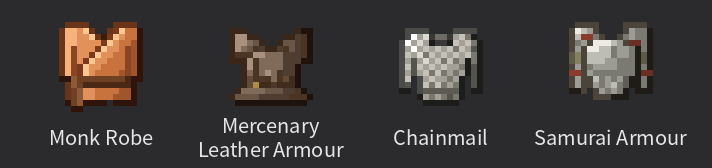
| Monk Robe | Mercenary Leather Armour | Chainmail | Samurai Armour | |
|---|---|---|---|---|
| Class / material | Clothing / Cloth | Medium / Leather | Medium / Chain | Heavy / Metal Plate |
| Which slot it goes in | Body | Body | Shirt | Body |
| Cutting damage stopped | 1.6% / 3.8% | 24.6% / 58.4% | 20.9% / 44.6% | 40% / 81.25% |
| Blunt damage stopped | 1.2% / 2.9% | 16% / 38% | 8.6% / 20.5% | 26% / 61.75% |
| Share of stopped cutting damage that doesn’t turn into blunt | 60% | 70% | 70% | 90% |
| Harpoon damage stopped | 0 points | 14 / 33 points | 12 / 28.5 points | 36 / 85.5 points |
| Costs and bonuses of wearing it | Martial Arts +6 | Martial Arts −4; dodge 0.9× normal; Crossbows 0.9× normal | Dodge 0.9× normal; attack speed 0.97× normal; Crossbows 0.7× normal | Melee Attack −8; damage 0.85× normal; attack speed about 0.88× normal; Martial Arts −10; dodge 0.6× normal; Crossbows 0.5× normal |
The “Crossbows” cell also applies to Precision Shooting. For the full stats of every piece, see Body Armour and Shirts, Headgear, and leg and foot gear.
| Situation | Number | Notes |
|---|---|---|
| What happens when your armour breaks | You take 1.2× normal damage | It only breaks when durability runs out; an armour shop can repair it |
| What headgear costs you | It doesn’t slow your running or attacks, and doesn’t affect sneaking | It only stops damage |
See also
Link to the “See also” sectionOfficial siteHow to joinWorld mapFAQ
DustMoon.net is not an official product of Mojang Studios or Microsoft, and is not approved or endorsed by them.
DustMoon is inspired by the world of Kenshi and is not affiliated with Lo-Fi Games.
© 2026 DustMoon.net