
Money Flow
Most cats in this land come from someone else’s hands. What residents pay for meals goes to the shop, the shop’s surplus goes into a faction treasury, the treasury pays guards their daily wage, and the guards spend it on meals again. The mediation fee you pay, the bounty reward you collect for handing in a wanted man, and the cats a siege army takes are all part of this path. How much a treasury holds decides how strong that faction’s guards and soldiers who appear later will be.
Interactive charts
Link to the “Interactive charts” section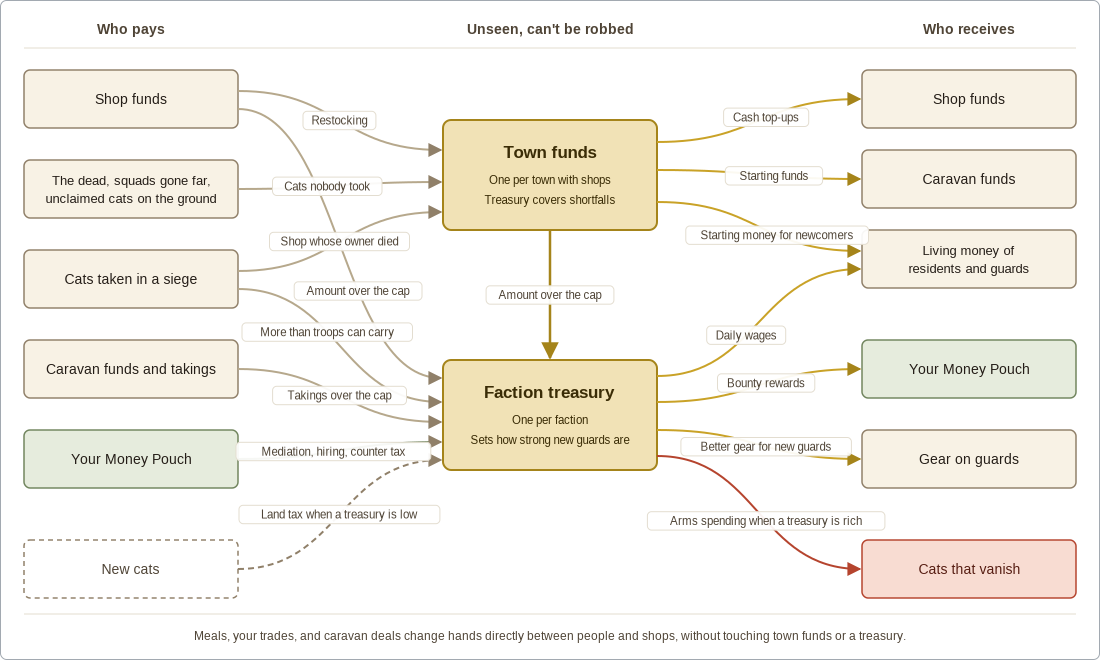
Who pays is on the left, who receives is on the right, and town funds and faction treasuries sit in the middle. The thicker the line, the larger its share of the cats that changed hands.
Hover over a box or line to read about it; click a box to lock it.
The chart is wider than the screen; swipe sideways to see it all.
All flows (table)
| Who pays | Who receives | What happens | Share |
|---|
Each dot is a person, place, kind of goods, or practice tied to cats and goods; its colour is its group. Lines point from what affects to what is affected, and thicker lines mean stronger links.
Hover over a dot to light up its links; click to lock it and read the details.
Drag empty space to move; scroll or pinch to zoom. Drag dots to move them.
Click a name to select it on the chart. "Dawn" means morning in the game, about every 20 real minutes.
Nobody can see or rob town funds and faction treasuries. To follow a single cat step by step as it changes hands, see The Flow of Cats.
Each box on the chart
Link to the “Each box on the chart” sectionShop tills. The cats each shop has on hand, shown as “Shop funds” in the trade window. Anything over the cap goes into the treasury of the faction that runs the shop; if that faction has no treasury, it goes into the town’s funds.
The dead, squads gone far, and unclaimed cats on the ground. These all end up in the funds of the nearest town with shops. While a body is still lying where it fell, its cats stay on it and can be looted.
Cats taken in a siege. They are shared out to the army members still standing, who carry them; catch the retreating army and knock them down to loot it back. What they can’t carry goes into the attacking faction’s treasury.
Caravan funds and takings. Starting funds come first from that town’s funds, and the caravan’s faction treasury covers any shortfall; takings over the cap go back to that treasury.
Your Money Pouch. Mediation fees, what you pay in a bar to hire a mercenary, joining fees, and dues go into the treasury of the faction collecting them. When you buy from another traveller’s shop counter, 5% tax comes out of what the seller receives.
New cats. When a faction that owns towns runs low, it taxes the farms and villages outside its towns at every dawn.
Town funds. Every town with shops has its own. Starting money for newcomers, shop cash top-ups, and caravan starting funds all come from here first; anything over the cap goes into the town owner’s treasury.
Faction treasury. Factions that own a town with shops each have one, as do the eight factions with Pacifiers (the Holy Nation, the United Cities, the Shek Kingdom, the Traders Guild, the Slave Traders, the Anti-Slavers, the Flotsam Ninjas, and the Hounds) and the Shinobi Thieves. A faction that takes a town later starts its treasury at zero.
Living money of residents and guards. At every dawn, people with a daily wage are paid from their faction’s treasury; if their faction has none and they live in a town, the town owner’s treasury pays.
Bounty rewards you receive. They come out of the treasury of the faction taking the prisoner, paid in full even when the treasury is short; see Bounty Hunting.
Gear on guards. Factions whose treasury is Ample or better pay for better gear for newly appearing guards and soldiers; if one leaves without dying, the gear is turned back into cats and returned to the treasury.
Cats that vanish. A faction with too much in its treasury buys arms from workshops abroad at every dawn. That money goes to people outside this land and is gone for good.
Examples: where the cats come from and where they go
Link to the “Examples: where the cats come from and where they go” sectionA guard’s day. At dawn, a United Cities guard draws his daily wage from the United Cities treasury into his living money. He moves a little of it onto himself as change. At noon he eats at the bar, and the meal goes into the bar’s shop funds. When the bar’s funds go over the cap, the extra goes back to the United Cities treasury. At the next dawn, those cats become some guard’s wage again.
You go to a Pacifier. You are hostile with the Holy Nation and pay a Holy Nation Pacifier to put in a good word. The fee goes into the Holy Nation treasury, not onto the Pacifier, so knocking him down won’t get it back. Before you pay, the [Mediate] box tells you whose treasury the money goes into and whether the treasury will change state. A richer Holy Nation treasury means stronger Holy Nation guards and soldiers who appear later.
You hand in a wanted man. You carry a wanted man to an enforcer, and the reward comes out of the treasury of the faction taking him. The more you hand in, the less that faction’s treasury holds, and the weaker its guards who appear later.
A town falls. An army breaks into the town’s shops, the shop funds are shared out to the army members, and they retreat carrying them; what they can’t carry goes into the attacking faction’s treasury. In the fallen town, the cats of any shop whose owner died go into that town’s funds, and that is the money used first when the town tops up shop cash and pays starting money to new residents. For sieges, see Sieges.
A fight far away. Two squads clash somewhere you can’t see, and the losing side is wiped out. The winners loot the cats on the bodies; whatever they leave goes into the funds of the nearest town with shops after a while. The next new resident who moves into that town gets starting money from it.
The six states of a treasury
Link to the “The six states of a treasury” sectionA treasury’s cats are divided among that faction’s guards and soldiers; each one’s share is the per-head war chest. Based on it, a treasury is Empty, Strained, Steady, Ample, Rich, or Overflowing.
- How strong new troops are. The better the state, the more skill and the better armour and weapons that faction’s guards and soldiers have when they first appear; Strained and Empty factions are the opposite. People who have already appeared do not change. On the person’s name card, words such as “fine gear” follow their job.
- Daily wages. Strained and Empty factions can’t pay full wages, but always pay at least a quarter of the usual amount. The change guards carry shrinks with it.
- Treasuries drift back to the middle. A faction that owns towns and is low collects land tax at every dawn; a faction with too much spends on arms at every dawn. A faction with no towns does not refill once its treasury runs low.
- Where to see it. In the hotbar slot 9 menu, open [Faction Relations] and pick a faction: the gold ingot slot shows its state, such as “X treasury: Steady”, and that mediation fees go into this treasury. On the World Map, a town whose owner’s treasury is not Steady has an extra line in its details, such as “X treasury Rich: guards not met yet have more skill and fine gear”.
What you should do
Link to the “What you should do” section- To weaken a faction’s troops who appear later, drain its treasury: keep handing wanted people to that faction and collecting its rewards. Troops who have already appeared don’t get weaker.
- Mediation fees make that faction’s later troops stronger. Check the treasury state on the [Mediate] box before you pay.
- A retreating siege army carries the cats it took. Catch them and knock them down, and the cats are yours.
- Cats on squads gone far and on unsearched bodies end up in a nearby town’s funds. To get them, search the bodies while they are still there; see Looting.
| Situation | Number | Notes |
|---|---|---|
| How much shop funds can hold before the extra goes to a treasury | 25,000 cats for a normal shop | Some shops have a higher cap |
| How much caravan takings can hold before the extra goes back to a treasury | 25,000 cats | Some caravans have a higher cap |
| How much town funds can hold | 2× the caps of all shops in town added together | Anything over goes into the town owner’s treasury |
| How much a treasury starts with | 5,000 cats per guard and soldier | Fewer than 20 counts as 20; so every faction starts out Steady |
| Treasury Empty | Under 1,000 cats per head | New troops have 10 less skill and worn-out gear |
| Treasury Strained | 1,000–3,000 cats per head | New troops have 5 less skill and shoddy gear |
| Treasury Steady | 3,000–10,000 cats per head | New troops are as usual |
| Treasury Ample | 10,000–25,000 cats per head | New troops have 5 more skill and better gear |
| Treasury Rich | 25,000–60,000 cats per head | New troops have 10 more skill and fine gear |
| Treasury Overflowing | 60,000 cats or more per head | New troops have 15 more skill and top-grade gear |
| When a shrinking treasury drops a state | Per-head share falls below 90% of that state’s lower bound | It moves up as soon as it crosses the lower bound |
| Extra gear cost a treasury pays per new trooper | Ample 1,300, Rich 2,300, Overflowing 3,200 cats | If it can’t pay, the trooper drops one state; refunded if he leaves alive |
| What share of the daily wage is paid | Per-head share ÷ 3,000, up to the full wage | Never less than a quarter of the usual wage |
| Living money at which the daily wage stops | 5,000 cats | |
| Land tax when a treasury is low | Each dawn, a tenth of the shortfall | Only below 3,000 per head; the shortfall is measured up to 3,000 per head |
| Arms spending when a treasury is rich | Each dawn, a twentieth of the excess | Only above 10,000 per head; gear paid for new troops the day before is subtracted first |
| Shop counter tax | 5% of the sale price | Goes into the town owner’s treasury if the counter is in a town; vanishes outside towns |
See also
Link to the “See also” sectionOfficial siteHow to joinWorld mapFAQ
DustMoon.net is not an official product of Mojang Studios or Microsoft, and is not approved or endorsed by them.
DustMoon is inspired by the world of Kenshi and is not affiliated with Lo-Fi Games.
© 2026 DustMoon.net