
Prices and Trading
Every item has a local price in every town. The local price is the base price multiplied by the town’s trade culture, and for trade goods also by the market in that area. Shops stock their shelves at the local price and buy your goods at the local price too, only with a discount when buying. Trade goods aren’t discounted, and gear is discounted the most. To earn from trading, carry trade goods to a town where the price is high and sell them there.
Local price
Link to the “Local price” sectionThe “Value” line at the bottom of an item’s description is its base price, with the quality and grade of weapons and armour already included: of two blades of the same type, the better one is simply worth more.
In a town, the base price is multiplied by two more layers:
- Trade culture: each town has a trade culture of its own, set by the faction in power. A few items have a separate multiplier here; see Trade culture below.
- Market: only trade goods are multiplied by this layer. Each town’s market lies within 30% above or below the baseline, and the same town always has the same figure. The market changes gradually across the map, so neighbouring towns are usually much alike, and you have to travel far enough for a real difference.
A few high-priced trophies have a fixed price that is the same everywhere; see Data at the bottom of the page.
What shops pay for your goods
Link to the “What shops pay for your goods” section| Item | Buying price |
|---|---|
| Trade goods: raw materials and building materials, crops, drink and drugs, first aid supplies and repair kits, printed books (histories, scripture, newspapers), ancient artifacts and parts, horns and teeth | Full local price |
| Weapons, armour, clothing, crossbows | A quarter of the local price |
| Others: food, prosthetics, backpacks, bolts, maps, letters and notes, and so on | Half the local price |
| Stolen goods | Halved again after the above (the Black Market is counted separately) |
Trade goods buy and sell at the same price within one town, so there is nothing to gain or lose. Anything else bought and sold back at the same shop always loses money. For a Katana with a local price of ten thousand, the shop pays only two thousand five hundred.
A few kinds of item are adjusted down further:
- Food is bought by cooking quality: below 100% quality you get proportionally less, and uncooked food counts as only 50%. Above 100% adds nutrition only, not money.
- Homemade items (with “ (Homemade)” after the name) have a buying price capped at 90% of the lowest cost of the materials, so processing and reselling earns nothing extra. Weapons, armour, and crossbows you forged yourself don’t sell for more than the standard item of the same type either.
- Uniforms: clothing and armour looted from someone wearing a uniform, with a description marking it as a faction’s uniform, is worth only 30%.
- First aid kits and Skeleton Repair Kits are bought by the uses left.
- Bolts are counted one by one, not as a whole bundle.
Trade culture
Link to the “Trade culture” sectionA town’s trade culture bears on three things: which items the local shops don’t stock, which are contraband, and which few items are priced especially high or low. Which one applies depends on who is in power in the town.
| Trade culture | Factions using it | Contraband | Special multipliers |
|---|---|---|---|
| Empire | United Cities, Traders Guild, Empire Peasants | Hashish, Bloodrum, Hemp | Hashish ×12, Bloodrum ×4, Hemp ×4, Sake ×1.5 |
| Free Traders | Free Traders | Same as Empire | Same as Empire |
| Empire (Lawless) | Tech Hunters, Anti-Slavers, Machinists, Scavengers, the Gorrillo Bandits | None | None |
| Shek Kingdom | Shek Kingdom | Hashish | Hashish ×3.5 |
| Holy Nation | The Holy Nation | Hashish, Ancient Science Book, AI Core, several banned books, and five transcripts | Hashish ×4 |
| Swampers | Swampers, Reavers, Stone Rats, Hounds, Blackshifters, Grayflayers | None | Bread, Foodcube, Meatwrap, Bloodrum, Cactus Rum ×1.25; Gohan, Hemp, Riceweed, Sake ×0.75; Wheatstraw ×0.2 |
| Slave Traders | Slave Traders | Hashish, Bloodrum, Hemp | Hashish ×6, Bloodrum ×4, Hemp ×4, Sake ×1.5; Raw Stone, Building Material, Iron Plates, Raw Iron, Copper ×0.5; Wheatstraw, Cactus, Cotton ×0.4 |
Towns of other factions and the wild have no trade culture: no multipliers and no contraband.
Eleven places also have their own prices for hemp products: Hashish ×5 and Hemp ×3, replacing the usual multipliers. The eleven are Catun, Clownsteady, Mourn, Flats Lagoon, the Slave Market, Tengu’s Vault, Drifter’s Last, Eyesocket, Manhunter Base, Slave Farm, and Slave Farm South.
Something a shop doesn’t stock isn’t necessarily unsellable. Ordinary “not stocked” only means it isn’t on the shelf; take it in to sell and the shop still buys it. Only contraband is truly refused.
Contraband
Link to the “Contraband” sectionWhere an item is banned, shops don’t stock it and ordinary merchants won’t pay a single cat for it: “Unable to sell - contraband in this area”. A Traders Guild shop says “Unable to sell - the Traders Guild won’t buy this”.
The high multipliers on contraband only count on the Black Market. Only the Shinobi Trader inside a Thieves Guild tower will buy it (a very few shops that specialise in smuggling excepted), and he pays only half; see Black Market and Fencing. Or carry it somewhere it isn’t banned and sell it there.
Take Hashish (base price 800):
- In an Empire town such as Heft, regular shops refuse it, and the Shinobi Trader pays about 4,800.
- In Mourn and Flats Lagoon, the Tech Hunters don’t ban it and these are among the eleven places, so any shop buys it at about 4,000.
- On Swamper land the multiplier is 1, so about 800.
All three figures are still multiplied by the local ±30% market. Carrying it through a town gate gets you searched; see Gate Search.
Special shops
Link to the “Special shops” sectionA few shops multiply their whole buying and selling prices by one figure:
- The Crab Man shops in Crab Town and Crab Village: ×1.5. They pay 50% more for your goods and charge 50% more for theirs.
- The merchants at the Slave Farms, and the shops selling slaves’ old clothes in the Slave Market and Eyesocket: ×0.5.
- The Thief Fence and the Shinobi Trader: always half price; see Black Market and Fencing.
Price rise after a siege
Link to the “Price rise after a siege” sectionAfter a town has been attacked by an army, prices in its shops go up. The heavier the losses, the bigger the rise: +10% at the lightest, +200% for a town that was destroyed. If the town’s food was robbed or handed over, food rises a step further.
Prices slowly return to normal within 30 to 180 minutes. The shelves show “+N% after the siege, back to normal in about M min”.
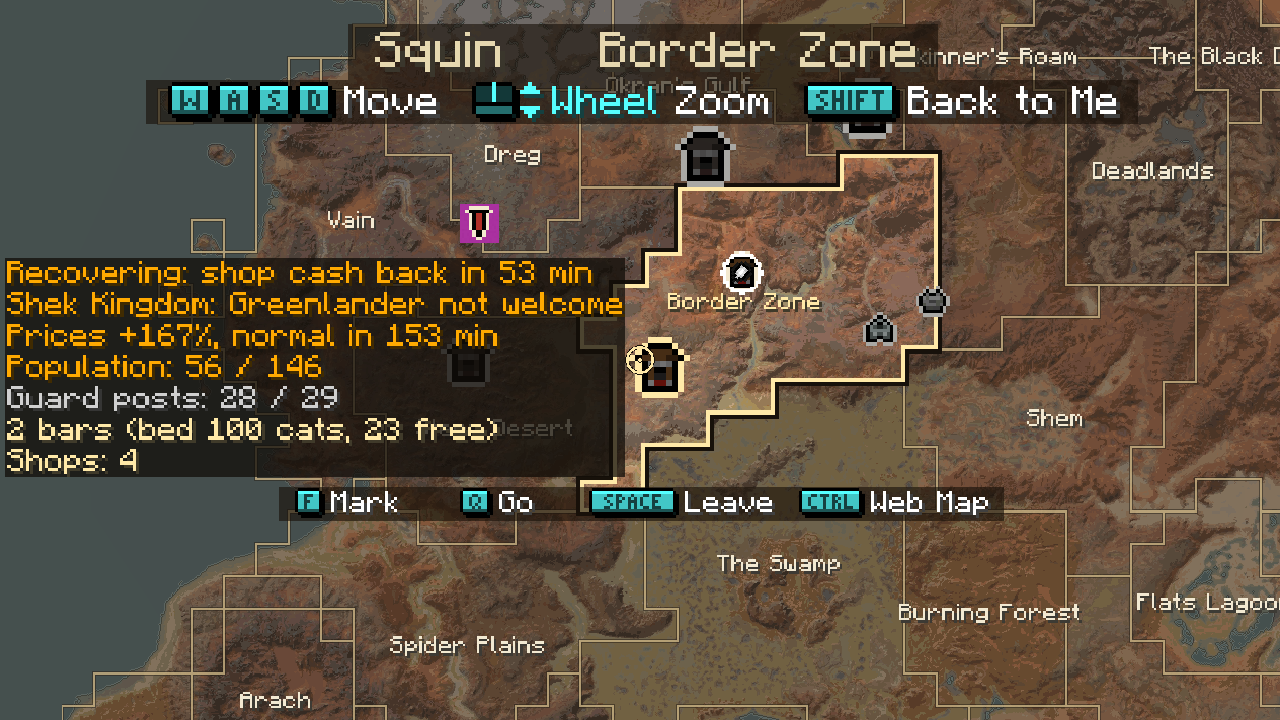
Buying prices rise as well, so bringing goods in from elsewhere to sell pays best. There are three conditions, though:
- Things bought in the same town and brought back to sell don’t count.
- The extra from the rise is paid in cash only; the shop doesn’t cover it with Shop Debt.
- Each shop pays at most 5,000 cats extra during one price rise.
For how losses are worked out, see Battle Reports.
How to run a trade route
Link to the “How to run a trade route” section| Situation | Number | Notes |
|---|---|---|
| What something sells for locally | Base price × that town’s trade habits × market | The market only affects trade goods |
| How much the market varies | 0.7×–1.3× the base | Fixed for each town; about 8,192 blocks apart before it changes noticeably |
| What shops pay for trade goods | The same as the local selling price | Same price to buy and sell within a town |
| What shops pay for weapons, armour, clothing and crossbows | A quarter of the local price | |
| What shops pay for everything else | Half the local price | |
| What regular shops pay for stolen goods | Half again | |
| What decides the price of food | Buying price × quality (100% at most) | Uncooked food counts as 50% |
| Most you can sell things you made for | Cheapest cost of the materials × 90% | |
| What a uniform looted from someone wearing it sells for | 0.3× | |
| Which items have fixed prices | Leviathan Pearl 12,000, Fog Prince Head 6,000, Beak Thing Egg 4,200 cats | Trade habits and market don’t apply |
| What hemp sells for in the eleven places | Hashish 5×, Hemp 3× | Replaces the usual multipliers |
| Crab Man shops’ buying and selling | 1.5× | Crab Town, Crab Village |
| Slave Farm merchants and shops selling slaves’ old clothes | Half | Both buying and selling |
| How much prices rise after a siege | Up 10%–200% | A further 1.5× if food was robbed, up 200% at most |
| How long the rise lasts | 30–180 minutes | Slowly back to normal the whole time |
| Most extra a shop pays you during a rise | 5,000 cats per shop | For each rise |
See also
Link to the “See also” sectionOfficial siteHow to joinWorld mapFAQ
DustMoon.net is not an official product of Mojang Studios or Microsoft, and is not approved or endorsed by them.
DustMoon is inspired by the world of Kenshi and is not affiliated with Lo-Fi Games.
© 2026 DustMoon.net