
Weapons
Melee weapons fall into six classes, and whichever class you use is the skill you train. When choosing a weapon, look at its balance of cutting and blunt damage, its length and weight, and the quality of that particular weapon. What tool the icon looks like has no effect on how strong it is.
The six classes
Link to the “The six classes” sectionEach class has a skill of the same name. That skill decides how quickly you strike, and also the angle and number of people of your big attack (see Melee Combat and Special Moves). The tag such as [Sabres] on the line under the name in the description box is the class.
- Katanas (6): almost pure cutting, and the fastest to strike. Positive attack bonus, negative defence bonus, negative armour penetration, poor against heavy armour, and only sixty percent damage against Skeletons and machines. Their big attack hits the fewest people. The Topper is the exception: no attack or defence modifiers, and no reduction against machines.
- Sabres (6): mostly cutting with a little blunt. The attack bonus is mostly negative, the defence bonus positive. The Desert Sabre does especially high damage to Spiders and Skimmers.
- Hackers (6): roughly half cutting and half blunt, mostly +30% armour penetration, higher damage against machines, slightly weaker against animals.
- Heavy Weapons (5, two-handed): mostly blunt, long and heavy, the slowest to strike, but their big attack hits the most people, and everyone it hits takes full force. Attack is 4–6 lower when you strike indoors. The Falling Sun is the exception, with more cutting than blunt.
- Blunt (6): very little cutting, so most of the damage heals by itself, but it can knock people out all the same. A hit on the body makes a dull thud and draws almost no blood. The Jitte and Heavy Jitte have defence +8; the Mercenary Club and Spiked Club have armour penetration +30%.
- Polearms (5, two-handed): attack bonus +4 to +8, long reach, and mostly higher damage against animals; Attack is 4–8 lower when you strike indoors, and the attack bonus doesn’t count there. When their big attack sweeps someone right beside you, the damage is halved.
For the stats of all 34 one by one, see Melee Weapons; crossbows work differently, see Crossbows.
Base attack is the same for all
Link to the “Base attack is the same for all” sectionEvery weapon has the same base attack; the differences are all in the lines of the description box (for what each line means, see Damage Types).
- Reach follows the weapon’s length, measured from the centre of your body to the blade tip: Wakizashi 1.5 blocks, Katana about 1.8 blocks, Naginata and Polearm about 2.1 blocks, Bull Horn Axe and Fragment Axe about 2.3 blocks. A swing from beyond that distance hits nothing. For the number of each weapon, see Melee Combat.
- The attack interval is broadly longer for heavier weapons: a beginner strikes about every 0.55 seconds with a Katana and about every second with a Fragment Axe. With the skill for that class and Dexterity fully trained, the interval is a little over half; carrying too much or lacking Strength slows you down.
Two-handed weapons
Link to the “Two-handed weapons” sectionHeavy Weapons and Polearms, 10 in all, have an extra [Two-handed] next to the class in the description box.
- You can’t swing them while carrying someone.
- With your left arm unusable you can still swing them, but you can’t block, and you strike at half speed. For severed arms and crippling, see Crippling and Limb Loss.
Strength requirement and weight
Link to the “Strength requirement and weight” sectionThe Strength requirement is shown in the description box. It is this weapon’s blunt damage × 40 or its base weight, whichever is larger. Most blades need only single digits; the Bull Horn Axe and Fragment Axe need nearly 60.
Without enough Strength you can still pick a weapon up; you just swing it slowly and block badly. Each missing level makes you 1.5% slower, and past 20 levels it gets no slower, for at most thirty percent. Strength above the requirement gives nothing extra. On the other hand, swinging weapons whose Strength requirement is above yours (“Swing a too-heavy weapon” on the [Skills] page) makes Strength grow quickly; easy weapons barely train it.
Weight counts towards your load (see Survival and the Body). The more blunt damage a weapon does, the heavier it is; the same weapon also weighs differently depending on the manufacturer.
Quality: model and manufacturer
Link to the “Quality: model and manufacturer” sectionEvery melee weapon has a model and a manufacturer, shown on the bottom two lines of the description box, [Model # …] and [Manufactured by …]; the name only shows the weapon itself.
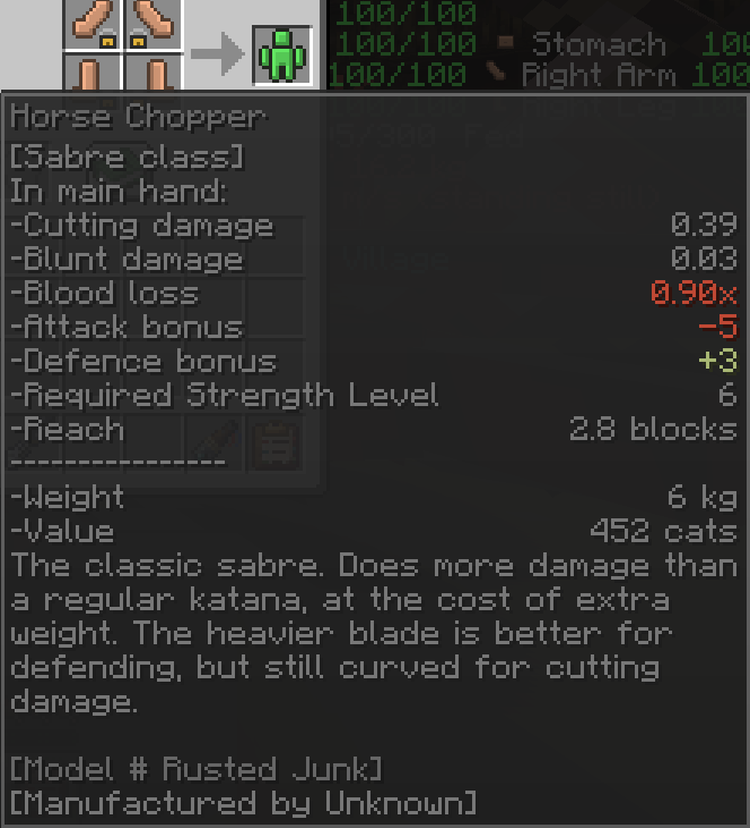
- Models come in 15 tiers, from Rusted Junk to Meitou. The model decides the cutting and blunt multipliers: cutting from ×0.385 to ×2, blunt from ×0.1 to ×2. Only Rusted Junk also takes 1 off both attack and defence.
- Manufacturers differ too: Ancient has a tenth less cutting but is thirty percent lighter; Catun Scrapmaster has a fifth more blunt and is a fifth heavier; Cross and Edgewalkers have a tenth more cutting; Skeleton Smiths are just a little more expensive; Unknown goods have no stat reduction and cost only thirty percent; Homemade is base in everything.
- Different quality also means different weight, Strength requirement, and value. A weapon with no model shown always counts as Homemade Catun No.3.
- However low the quality, there is a minimum damage: the weakest blow is a quarter of the strongest. A melee weapon you hold has cutting of at least ×0.3625; a blunt-type weapon, whose blunt is higher than its cutting, has blunt of at least ×0.3625 and cutting of at least ×0.145. An ordinary weapon in a resident’s hands has cutting of at least ×0.475; a blunt-type one, blunt of at least ×0.475 and cutting of at least ×0.19. Only weapons below the minimum are raised, such as a Rusted Junk iron rod; mid- and high-quality weapons keep their numbers. Unarmed Martial Arts and crossbows aren’t affected. The cutting and blunt shown in the tooltip and on the inventory screen are the real values after raising.
Where they come from: the weapon a passer-by carries depends on who they are and how strong they are; a shop’s stock depends on where that shop gets its goods; storage chests hold another batch again; a weapon you make yourself has the manufacturer Homemade, and its model depends on your weapon smithing skill, the Smithing Table, and the blueprints you have learned (see Recipes: Smithing Table, Anvil and Loom). For how prices are set, see Quality and Grades.
Wear: weapons break down with long use, but they don’t disappear. A broken weapon does only eighty percent damage, and a weapon shop can repair it.
Weapon slots and carrying
Link to the “Weapon slots and carrying” sectionHotbar slot 1 is your main weapon and slot 2 your secondary weapon.
- These two slots only take weapons or crossbows you put there yourself (clicking, dragging, number keys, and F all count).
- Things you pick up, move with Shift, or are given are moved to other slots. So someone fighting unarmed with Martial Arts doesn’t suddenly find loot in their hand after picking something up.
- Things that aren’t weapons can’t go in these two slots.
- When you hold slot 1, the weapon in slot 2 hangs on your body; when you hold slot 2, the one in slot 1 hangs on your body; when you hold another slot, both hang there.
- Only the weapons in these two slots always hang on your body. When you put away a weapon from another slot and that spot on your body is already taken, it goes into your inventory, and the screen says why.
- 20 shorter one-handed weapons hang at the hip, the rest on the back (see the Data table below); while climbing a wall, they all go on the back.
How you hold a weapon only changes its look, not its stats:
- Out of combat, crouch and right-click to cycle: stowed → resting on the shoulder → held in both hands → held in one hand. The screen shows the current way, for example “Weapon: stowed”.
- Press F to draw it straight into one hand.
- Every swing switches to a two-handed grip for 5 seconds.
- A plain right-click is block, not a change of grip. See Blocking and Dodging.
| Class | Skill | Weapons | Two-handed | Carried |
|---|---|---|---|---|
| Katanas | Katanas | Guardless Katana, Katana, Ninja Blade, Nodachi, Topper, Wakizashi | No | Nodachi and Topper on the back; the rest at the hip |
| Sabres | Sabres | Desert Sabre, Foreign Sabre, Holed Sabre, Horse Chopper, Longsword, Ringed Sabre | No | At the hip |
| Hackers | Hackers | Combat Cleaver, Flesh Cleaver, Long Cleaver, Moon Cleaver, Paladin’s Cross, Short-Cleaver | No | Long Cleaver and Paladin’s Cross on the back; the rest at the hip |
| Heavy Weapons | Heavy Weapons | Bull Horn Axe, Exile Plank, Falling Sun, Fragment Axe, Plank | Yes | On the back |
| Blunt | Blunt | Heavy Jitte, Iron Club, Iron Stick, Jitte, Mercenary Club, Spiked Club | No | At the hip |
| Polearms | Polearms | Heavy Polearm, Naginata, Naginata Katana, Polearm, Staff | Yes | On the back |
Models (the higher the level, the better; cutting multiplier = 0.3 + 0.017 × level, blunt multiplier = level ÷ 50):
| Model | Level | Cutting damage (× normal) | Blunt damage (× normal) | Manufacturer |
|---|---|---|---|---|
| Rusted Junk | 5 | 0.385 | 0.1 | Homemade, Unknown (attack and defence −1 each) |
| Rusting Blade | 10 | 0.47 | 0.2 | Homemade, Unknown |
| Mid-Grade Salvage | 15 | 0.555 | 0.3 | Ancient, Homemade |
| Old Refitted Blade | 20 | 0.64 | 0.4 | Ancient, Homemade |
| Refitted Blade | 25 | 0.725 | 0.5 | Ancient, Homemade |
| Catun No.1 | 30 | 0.81 | 0.6 | Catun Scrapmaster, Homemade |
| Catun No.2 | 35 | 0.895 | 0.7 | Catun Scrapmaster, Homemade |
| Catun No.3 | 40 | 0.98 | 0.8 | Catun Scrapmaster, Homemade |
| Mk I | 50 | 1.15 | 1.0 | Skeleton Smiths, Homemade |
| Mk II | 55 | 1.235 | 1.1 | Skeleton Smiths, Homemade |
| Mk III | 60 | 1.32 | 1.2 | Skeleton Smiths, Homemade |
| Edge Type 1 | 70 | 1.49 | 1.4 | Edgewalkers, Homemade |
| Edge Type 2 | 75 | 1.575 | 1.5 | Edgewalkers, Homemade |
| Edge Type 3 | 80 | 1.66 | 1.6 | Edgewalkers, Homemade |
| Meitou | 100 | 2.0 | 2.0 | Cross |
Manufacturers (multiplied on top of the model):
| Manufacturer | Cutting damage (× normal) | Blunt damage (× normal) | Weight (×) | Price (×) |
|---|---|---|---|---|
| Ancient | 0.9 | 1.0 | 0.7 | 0.8 |
| Catun Scrapmaster | 1.0 | 1.2 | 1.2 | 1.2 |
| Cross | 1.1 | 1.0 | 1.0 | 2.0 |
| Edgewalkers | 1.1 | 1.0 | 1.0 | 1.4 |
| Skeleton Smiths | 1.0 | 1.0 | 1.0 | 1.2 |
| Unknown | 1.0 | 1.0 | 1.0 | 0.3 |
| Homemade | 1.0 | 1.0 | 1.0 | 1.0 |
Other:
| Situation | Number | Notes |
|---|---|---|
| How much Strength this weapon needs | The larger of blunt × 40 and the base weight | Blunt is this weapon’s value after quality |
| What happens without enough Strength | 1.5% slower for each missing level | Up to 30% slower at 20 or more short, for both striking and blocking |
| How heavy the weapon is | The larger of base weight × manufacturer’s weight multiplier and 20 × blunt × weapon weight factor | Staff, Jitte, Heavy Jitte, polearms and Holed Sabre have a factor below 1 |
| How often you can strike | 0.55–1 second as a beginner; 0.3–0.55 seconds fully trained | Depends on the weapon; roughly, heavier is slower |
| How much skill speeds up your strikes | The interval gets up to 45% shorter | The weapon class skill counts 70%, Dexterity 30% |
| How far the weapon reaches | 1.5–2.3 blocks | From body centre to blade tip |
| What grade a weapon with no quality marked counts as | Homemade Catun No.3 | Cutting 0.98×, blunt 0.8× |
| Lowest damage for your weapons | Cutting at least 0.3625× | Blunt types: blunt at least 0.3625×, cutting at least 0.145× |
| Lowest damage for residents’ weapons | Cutting at least 0.475× | Blunt types: blunt at least 0.475×, cutting at least 0.19× |
| What happens when a weapon breaks | Damage 0.8× normal | A weapon shop can repair it |
| How long you hold the weapon two-handed after a swing | 5 seconds | Looks only |
See also
Link to the “See also” sectionOfficial siteHow to joinWorld mapFAQ
DustMoon.net is not an official product of Mojang Studios or Microsoft, and is not approved or endorsed by them.
DustMoon is inspired by the world of Kenshi and is not affiliated with Lo-Fi Games.
© 2026 DustMoon.net