
Wounds, Blood and Recovery
Wounds come in two kinds: bruising slowly heals by itself, and cut damage does not. Unbandaged cut damage also gets worse. Only an arm or leg being cut off makes you bleed.
For how body parts and blood themselves work, see Body Parts and Health. This page covers how wounds change and what it takes for them to heal.
Two kinds of wound
Link to the “Two kinds of wound” sectionEvery blow of damage is split into a cutting share and a blunt share, in a ratio that depends on the weapon (see Damage Types).
- Bruising (left by blunt damage): slowly heals by itself and does not worsen.
- Cut damage: never heals by itself. A body part can recover naturally only up to “the maximum minus the cut damage”, and the rest depends on bandaging.
The share blocked by armour becomes bruising. A sword stroke you block counts as blunt in full. Wounds not caused by fighting, such as falls and suffocation, also always count as bruising.
Telling them apart is simple: a part marked “Needs bandage” under Body status has cut damage. One marked “Healing” has only bruising left. Using a first aid kit on someone with only bruising gets the line “Only bruises left. Bruises mend over time.”
Wounds worsening
Link to the “Wounds worsening” sectionWhen the unbandaged cut damage on a cell builds up to two tenths of that cell’s maximum, it starts to worsen: the health of that cell drops every second.
- The heavier the cut damage, the faster it worsens. At three tenths it runs at the base rate, and each further tenth adds the base rate again (6 times at eight tenths). Once cut damage exceeds the maximum, it jumps straight to 28 times. While the part is still above 0, the rate is halved.
- The higher your Toughness, the slower it worsens. 1.7 times at Toughness 0, 1 time at a Toughness of about 42, and almost no worsening at Toughness 100.
- In numbers: one sword wound of two or three tenths on a newly created character loses about 2 points a minute. Left until the cut damage exceeds the maximum, it is over a hundred points a minute.
Where it shows: that cell on the scoreboard on the side flashes. When the scoreboard is not showing body parts, the screen shows “Wounds are worsening and need bandaging”. Body status reads “Worsening”, and a part that is still getting worse reads something like “Left Arm worsening”.
While you are awake and a wound on a vital part is getting worse, the action bar shows a faint estimate of how long until you collapse: within 120 seconds it reads “Wound worsening: unconscious in about N s, bandage it with a first aid kit”, and from 121 seconds to 10 minutes “Wound worsening: unconscious in about N min, bandage it with a first aid kit”. When the estimate is more than 10 minutes away, nothing is shown.
There are only two ways to stop worsening: bandage that cell (it stops on contact, and starts again only if you are cut again), or lie in a bed. Skeletons and arms and legs fitted with prosthetics do not worsen, but a Skeleton’s head, chest, and stomach worsen all the same.
Deep coma: death if nobody bandages you
Link to the “Deep coma: death if nobody bandages you” sectionWhen worsening takes a vital through the deep coma line (−10 − 0.75 × Toughness), you see “Wounds worsened into a coma”, and the status reads “Deep coma: Needs bandaging”. You wake only when the vitals are back above 0.
While unconscious the body recovers about 2.4 points per second by itself, but only bruising. If the cut damage alone on some vital already puts it below 0, it never comes back up and keeps worsening (at only one tenth of the usual rate), and in the end that is death. The waiting bar then says “Dies in ~N”.
Only bandaging helps at that point. With a bandage, cut damage is restored on the spot. Once the vitals are back above 0, you can wake. Logging off in a deep coma is no escape either: you are still lying in the same place when you come back.
Blood loss
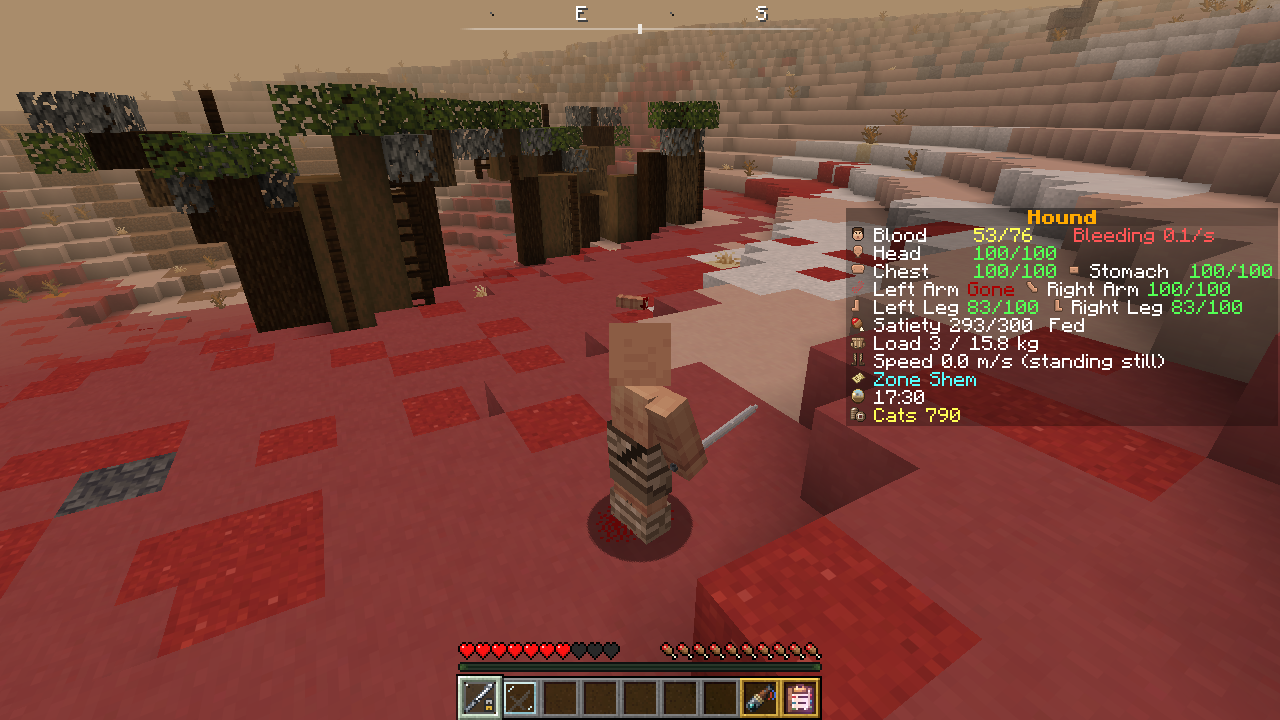
Link to the “Blood loss” sectionOrdinary cuts do not make you bleed. Only when an arm or leg is cut off does the stump start to bleed.
At the moment of severing:
- 6 to 30 points of blood are lost at once. The heavier the cut damage that limb already had, the closer to 30. For a traveller, this one loss also never exceeds three tenths of the blood maximum. So with blood still full, even a single stroke that cuts off an arm does not kill you through blood loss on the spot.
- The stump keeps bleeding. This bleeding does not stop by itself and has to be stopped by bandaging, or by fitting a prosthetic to the stump.
How fast it flows depends on two things: the heavier the cut damage on that limb, the faster it flows, and a limb broken off purely by a blunt weapon hardly bleeds. It is then multiplied by the race’s bleed rate. A Greenlander who loses an arm loses about 0.16 points per second at the fastest. That is not fast, but it does not stop by itself.
Blood dropping to 0 or below is a Blood-loss KO (“Passed out from blood loss”). After that it has to drop to −25 points before blood loss makes you pass out once more. At the negative of the blood maximum you die.
On screen: the Blood row on the scoreboard on the side reads “Bleeding X/s” (for a Skeleton, Oil with “Leaking X/s”), and Body status adds “Bleeding” after the cell of the stump. When blood is already negative and still flowing, “Now” reads Dying, with the instruction to stop the bleeding.
The bleeding alerts on the action bar (“Bleeding: … (-N per second)”) appear only when the flow reaches 0.5 per second. Losing an arm bleeds about 0.16 per second at most, so the alert usually does not appear, and you have to read the numbers on the scoreboard and in Body status yourself.
Natural recovery
Link to the “Natural recovery” section- Awake: bruising recovers about 0.05 points per cell per second, multiplied by the race’s healing rate (Scorchlander 1.1, Shek 0.8, Skeleton 2.0, the rest 1.0). A cell of 100 points takes over half an hour to go from 0 to full.
- In a bed: 8 times faster in a town bed and 4 times faster in a Camp Bed. An ordinary bed does not speed up a Skeleton; only a Skeleton Repair Bed works. For the kinds of bed and how to lie down, see Sleep and Rest.
- Unconscious: about 2.4 points per second, and it continues while you are carried.
- Blood recovers along with it, at half the rate of the body parts. But while a stump is still bleeding, blood does not recover at all.
The cut damage share does not shrink however long you lie down. Bandage first, then go to bed.
Blood you can see
Link to the “Blood you can see” sectionWhen you are cut, blood sprays from the part that was hit, in a colour that follows race; a Skeleton sprays dark brown Oil. A bleeding person who lies or stands still gathers a pool underneath, and one who walks or crawls leaves a trail of blood along the ground.
What to do when it happens
Link to the “What to do when it happens” section- Stop the bleeding first. Bleeding from a stump does not stop by itself, and the longer it is left the more blood is lost.
- Then bandage the vitals, followed by the cut damage on the limbs. Bandaging follows this order anyway; see First Aid.
- Find a bed last, so that the remaining bruising heals a little faster.
| Situation | Number | Notes |
|---|---|---|
| How bad a cut must be before it starts worsening | Unbandaged and at 20% of the maximum or more | A bandaged part stops worsening until it’s cut again |
| The basic worsening rate | 0.04 points per second | Then multiplied by the two rows below |
| How much faster worse wounds get worse | 1× at 20–30%, then 1× more for each further 10%; 28× over 100% | 6× at 80%, 8× at 100% |
| How much Toughness slows worsening | 1.7 − Toughness × 0.0167 times | 1.7× at Toughness 0, about 0.03× at Toughness 100 |
| When the part is still above 0 | Worsening at half speed | |
| A vital in a deep coma | Worsening at a tenth of the speed | Only for a vital whose cut damage is too great to come back above 0 |
| When wounds don’t worsen | While lying in a bed; Skeletons and prosthetic limbs | A Skeleton’s head, chest and stomach still worsen |
| How fast you heal on your own while awake | 0.05 points per second × your race’s healing speed | Each part heals separately; bruising only |
| How fast you heal in a town bed and a Camp Bed | 8× and 4× | Only a repair bed works for Skeletons |
| How fast you heal locked in a cage | Twice as fast while awake (2×) | |
| How fast you heal on your own while unconscious | 2.4 points per second | It continues while you’re carried |
| How fast your blood comes back on its own | Half of what your body parts recover | Not while a stump is still bleeding |
| How much blood the severing blow costs | 6–30 points | For a traveller, at most three tenths of the blood maximum |
| How fast a stump keeps bleeding | (cut damage on that limb × 0.002)² points per second × your race’s bleed speed | Cut damage counts up to 2× the maximum; each severing adds at most 0.5 points per second |
| How fast each race bleeds | Greenlander 1.0, Scorchlander 0.9, Shek 0.9, Hiver 0.3, Skeleton 0.1 | |
| How low bleeding takes you before you pass out | Blood at 0 or below | After passing out once, only at −25 again |
| How low bleeding takes you before you die | Below the negative of your blood maximum | |
| When the action bar shows time until you collapse | When it’s 10 minutes away or less | Seconds up to 120, minutes from 121 (rounded down) |
| How fast you must bleed for a bleeding alert | 0.5 per second or more | The action bar alerts; the scoreboard and body status show the number as usual |
See also
Link to the “See also” sectionOfficial siteHow to joinWorld mapFAQ
DustMoon.net is not an official product of Mojang Studios or Microsoft, and is not approved or endorsed by them.
DustMoon is inspired by the world of Kenshi and is not affiliated with Lo-Fi Games.
© 2026 DustMoon.net