
Items
This world has 516 items, and every one has a weight, a value, and a description box. Read the description box and you know whether the item is worth carrying, what it is for, and how to repair it when it breaks.
How to read the description box
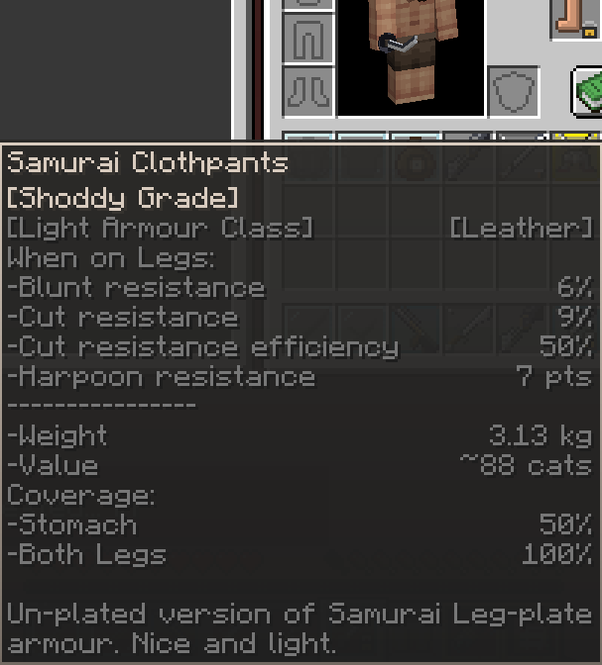
Link to the “How to read the description box” sectionHover over an item and its description box appears. The layout is fixed, from top to bottom:
- Name: the colour follows the grade or model, grey being the worst and yellow the best (see Quality and Grades). The name is the item’s own name only, without the quality.
- [Grade]: armour, clothing, crossbows, and prosthetics have an extra line under the name, such as [Shoddy Grade].
- [Class]: weapons show the weapon class, and two-handed weapons have [Two-handed] to the right. Armour shows the class with the material to its right, such as [Light Armour Class] [Leather].
- Stat rows: one stat per row, with the number on the right. Green text is in your favour, red is against you, and the rest is grey.
- After the divider: weight and value. Armour continues with coverage, skills, and weather protection sections.
- Description: the item’s background and use.
- The last two lines on weapons: [Model # …] and [Manufactured by …].
- Status lines: stolen, contraband, damaged, bound. They appear only when they apply.
Items without stats, such as food, medical supplies, and books, have only a line or two about their use, such as a line telling you to press Use to read.
The description box also states which station the item is made at (“Crafted at: Smithing Table”). For items that can’t be crafted it states the reason, such as “Cannot be crafted: only taken from certain foes”. This line is not shown while trading in a shop.
Weight and value
Link to the “Weight and value” sectionEvery item has a weight. The more you carry, the slower you run, the harder it is to dodge, and the sooner you get hungry (see Hunger). A few exceptions:
- Maps, blueprints, and single sheets such as letters, diaries, and wanted posters weigh 0 kg. Bound books and newspapers have weight.
- Cats are kept in the money pouch and weigh nothing (see Cats and Money Pouch).
- Items in the backpack on your back become lighter. Items in a backpack you are not wearing count at full weight (see Backpacks).
- The weight of a melee weapon changes with quality: for weapons with heavy blunt damage, the better the model, the heavier it is.
“Value” is the item’s base price. The value of armour, clothing, crossbows, and prosthetics follows the grade, and the value of weapons follows the model and manufacturer. The actual buying and selling prices in shops differ from town to town and also depend on where the item came from; see Prices and Trading.
Where things come from
Link to the “Where things come from” section- Shops: the Weapon Shops, Armour Shops, General Stores, and bars in each town each have their own stock (see Shops).
- Crafting: five kinds of station — Crafting Table, Cooking Stove, Smithing Table, Anvil, and Loom — with 410 recipes in all. 251 items can be crafted, and most need a blueprint or research first (see Workstations and Blueprints, Recipes and Research). More than twenty other items can only be crafted, such as cooked dishes, Compost, transcripts, and the Body Bag.
- Chests and ruins: chests in towns and ruins in the wilds (see Chests and Searching Ruins).
- From other people and animals: knock down an opponent and loot what they carry; some items are carried only by particular major figures; animal corpses yield hides and meat (see Looting and Harvesting Animals).
- Gathering: gathering spots in the wild and in towns (see Gathering Pick).
The 265 items that can’t be crafted fall under eight reasons; see Data at the bottom of the page.
How to use things
Link to the “How to use things” sectionAnything usable is held in your hand and used with Use (right-click by default): eating, drinking, bandaging, opening a book, unfolding a map, and repairing gear all work this way. Weapons go in hotbar slots 1 and 2 (see Weapons). Armour is worn. Prosthetics have to be fitted to the body (see Prosthetics, Wear and Repair Beds).
Wear and repair
Link to the “Wear and repair” sectionWeapons wear the more they are swung, and armour wears the more it is hit. Durability never drops below 1, so an item is never used up into nothing.
What damage does: a damaged weapon hits with only eight-tenths of its force. Wearing damaged armour, you take two-tenths more damage when hit. The description box gains a red line, such as “Damaged: Combat stats at 80%, use Steel Bars or take it to Weapon Shop for repair”. Clothing without protection stats that is damaged is only “Worn out; doesn’t affect any stats”.
Repairing it yourself: hold the matching material and press Use, and the item of that kind most in need of repair is repaired. The off-hand item comes first, then what you are wearing, then the hotbar, then the backpack.
One piece of material restores a portion of durability. Repairing to full costs roughly two-tenths to a quarter of the gear’s price. However expensive the item, it takes twenty pieces of material at most. For which material repairs which kind, see the table at the bottom of the page.
Taking it to a shop: Weapon Shops repair weapons and crossbows, and Armour Shops repair armour and clothing. A completely worn item costs a quarter of its original price, a half-worn item an eighth, with a minimum of 50 cats. A closed shop can’t repair anything.
Repair doesn’t remove the stolen mark. Stolen gear is still stolen after it is repaired.
Status marks
Link to the “Status marks” section- Stolen: anything taken from someone who is not a bandit. The description box reads “Stolen: taken from …; regular shops pay half price”. During a gate search, guards recognise things stolen from their own people and confiscate them (see Thievery and Gate Search).
- Contraband: “United Cities contraband: guards confiscate”.
- Bound: your most important set of gear is bound to your character, with a bound tag after the name, for example “Leather Pants [Bound: Legs]” (see Bound Gear).
When your inventory is full
Link to the “When your inventory is full” sectionItems owed to you don’t drop at your feet when your inventory has no room. They are held for you first: “Inventory full. … will be handed over when there is room”.
Once you free a slot, the items arrive soon. They arrive at once when you log in or close a chest or menu, and otherwise within 10 seconds at most. Hotbar slot 9 is the menu and doesn’t count as a free slot.
The Journal’s Items tab also lists the things you have seen (see Journal Tabs and Entries). This section is the complete reference.
Guide to the categories
Link to the “Guide to the categories” section| Page | Covers | In one sentence |
|---|---|---|
| Quality and Grades | — | Models and manufacturers for weapons; six grades for armour, crossbows, and prosthetics |
| Melee Weapons | 34 weapons | Stats, weight, value, and sources for the six weapon classes |
| Crossbows and Bolts | 7 crossbows, 4 kinds of bolt | Damage, range, reload, and which bolt each uses |
| Headgear | 41 items | Helmets, hoods, headwraps, hats, and masks |
| Body Armour and Shirts | 36 body items, 20 shirts | How to pair the outer layer with the inner layer |
| Legwear and Footwear | 29 leg items, 6 foot items | Trousers, leg plates, and boots |
| Backpacks | 16 kinds | How many extra slots, how much weight saved, and the cost of fighting with one on |
| Food and Drink | 15 foods, 6 dishes, 5 drinks and drugs, 5 farm produce | Nutrition, quality, and ingredients |
| Medical Supplies | 5 medical supplies, 2 Skeleton repair items, Bandage Cloth | What each treats and how long it lasts |
| Prosthetics | 20 limbs | Ten arms, ten legs |
| Materials and Tools | 21 materials, 3 building materials, 2 tools | What they are for and where they come from |
| Books and Wanted Posters | 139 books | Accounts, notes, newspapers, and wanted posters |
| Maps, Blueprints and Transcripts | 18 maps, 5 transcripts | Paper that reveals a location or teaches a recipe when read |
| Currency, Trade Goods and Miscellany | 50 trade goods and more | Things that exist only to be sold or handed in |
| Bound Gear | — | Others can’t take it, and you can trace it if you lose it |
Categories shown in the description box and their counts (not including items that can only be crafted):
| Category | How many | Category | How many |
|---|---|---|---|
| Books | 139 | Food | 15 |
| Armour | 95 | Items (misc and nest items) | 14 |
| Trade Goods | 50 | Crossbows | 7 |
| Clothing | 40 | Medical | 5 |
| Weapons | 34 | Drinks & Drugs | 5 |
| Materials | 21 | Farm Produce | 5 |
| Robotic Limbs | 20 | Bolts | 4 |
| Severed Limbs | 20 | Building Materials | 3 |
| Maps | 18 | Skeleton Repair | 2 |
| Backpacks | 16 | Tools | 2 |
| Blueprints | 1 | Total | 516 |
Reasons an item can’t be crafted (the line in the description box):
| What the description box says | Count | Notes |
|---|---|---|
| Only bought or found | 207 | The description box doesn’t show this line |
| Only obtained in combat | 20 | Severed limbs |
| Only taken from certain foes | 17 | |
| Obtained by gathering | 10 | |
| Only from certain places or conversations | 5 | |
| Only taken from animal corpses | 3 | |
| Obtained after drinking | 2 | |
| Only from certain starts | 1 |
Repair materials:
| Material | What it repairs | Material value |
|---|---|---|
| Steel Bars, Iron Plates | Weapons | 100 and 250 cats |
| Spring Steel, Crossbow Parts | Crossbows | 100 and 400 cats |
| Armour Plating | Metal plate armour | 1,000 cats |
| Chainmail Sheets | Chain armour | 1,000 cats |
| Leather | Leather armour | 400 cats |
| Fabrics | Cloth armour and clothing | 300 cats |
Other:
| Situation | Number | Notes |
|---|---|---|
| Hitting with a broken weapon | 0.8 times normal damage | |
| Being hit while wearing broken armour | 1.2 times normal damage taken | Clothing without protection stats is unaffected |
| How long a piece of gear lasts (maximum durability) | 80 / 160 / 320 / 640 | By value: under 1,000 / 1,000–4,999 / 5,000–11,999 / 12,000 and above |
| How much durability one lot of material restores | 5% to 100% of maximum durability | Material price ÷ a quarter of the gear’s price |
| What a shop charges to repair | A quarter of the original price × how worn it is | At least 50 cats |
| How soon held items reach you | Within 10 seconds at most | At once when you log in or close a menu |
See also
Link to the “See also” sectionOfficial siteHow to joinWorld mapFAQ
DustMoon.net is not an official product of Mojang Studios or Microsoft, and is not approved or endorsed by them.
DustMoon is inspired by the world of Kenshi and is not affiliated with Lo-Fi Games.
© 2026 DustMoon.net