
Sieges
Towns are attacked by whole armies. Hundreds of people march in from far away, gather outside the gate, charge into the town all at once to burn, kill, and plunder, and only withdraw when they can fight no longer. Whether or not you are there, it happens all the same.
For who the attackers are and what they enter the town for, see Besiegers and Their Aims. For the battle report, the reward for defending, and prices afterwards, see Battle Reports. An attack on your own outpost works differently; see Outpost Raids.
Which towns are attacked
Link to the “Which towns are attacked” section- Any defended town may be: there have to be at least two guards on their feet in the town.
- Ruins and landmarks aren’t towns and aren’t besieged.
- The Hub is never besieged.
- Several towns can be under attack at the same time, each with its own fight.
Sieges don’t happen often. After a town has been attacked, it is at least two hours and more before it is attacked again. A town usually goes many hours between one siege and the next.
The army really walks there
Link to the “The army really walks there” sectionAn army is around two hundred people, split into thirty-odd squads. The size depends on who the attackers are: some factions have few people, some as many as four or five hundred, and when beasts come in packs the numbers are far smaller.
The army sets out from several hundred to over two thousand blocks outside the town: nearby factions come from nearby, and expeditions come from the direction of their home. The army marches along the roads at about 4 blocks per second.
For a town with gates, the army attacks through the gate nearest to where it set out. It first gathers a hundred blocks or so outside the gate, and charges the gate together once everyone has arrived.
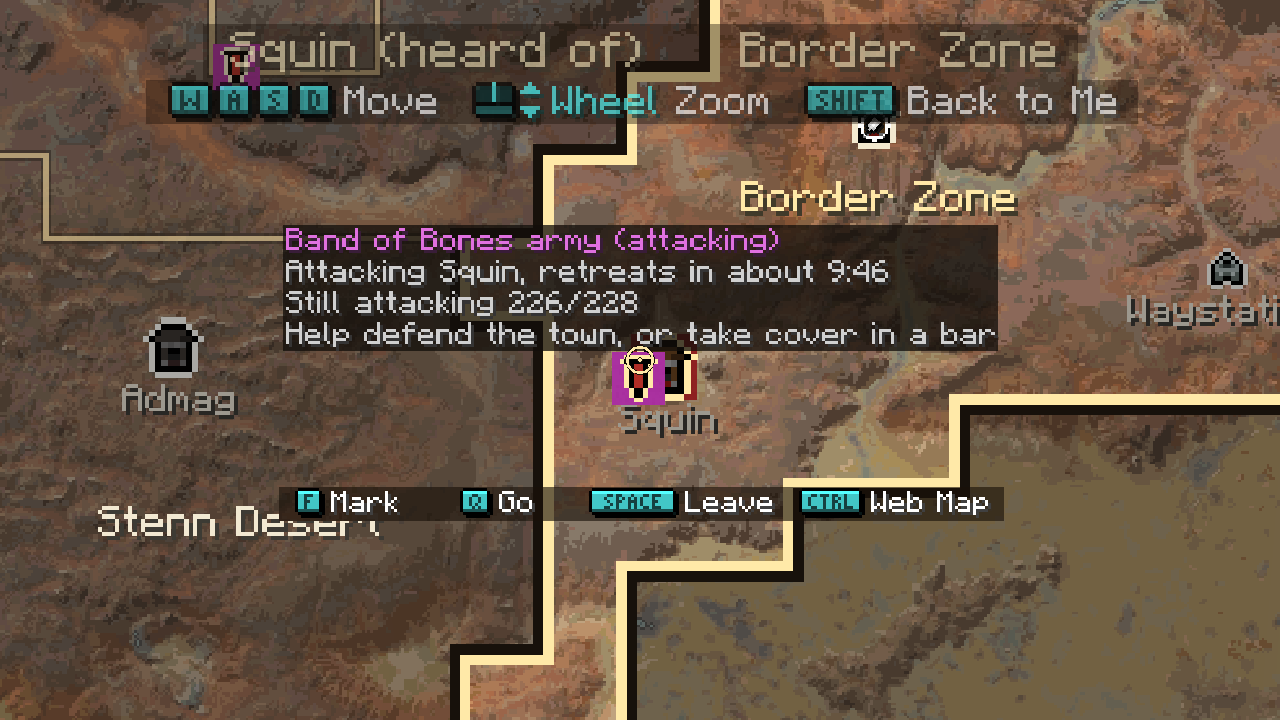
A marching army can be seen on the World Map. Its marker has a purple background, and the description says which town it is heading for, how long it will take, and how many people are left. A besieged town has a red background and says which gate the attackers are coming in by. For how to use the map, see World Map and Navigation.
The siege goes on when you aren’t there. With nobody watching, the army still marches, fights, robs shops, and retreats. If you arrive partway through, you see things as they stand at that moment, not from the beginning.
There is only that one body of people. The members of an army are fixed when it sets out. The dead stay dead, nobody replaces them, and nobody heals up to start again.
The alarm
Link to the “The alarm” sectionWhen the army comes within about 360 blocks of the town’s edge (for a walled town) or 240 blocks (with no walls), the alarm is raised in the town:
- One blast of a horn, and the word “Alarm” appears in the middle of the screen.
- A line in chat raising the alarm: who is heading for which town, and that they will come in by the north gate in about 1:30, for example. Hover over it to see the attackers’ goal, how many set out, and what you can do. Someone who only enters the town once the attack is under way instead sees that the attackers are coming into the town by the north gate.
- The bell in the town centre is struck 12 times in quick succession. While the army is still on the road, another round is struck every 20 seconds; once they are inside, it changes to one slow stroke every 15 seconds.
- The horn call changes. When the army charges the gate a charge is sounded and war music takes over in the town; at the retreat a retreat is sounded and the original music returns.
The status bar at the top of the screen
Link to the “The status bar at the top of the screen” sectionAfter the alarm has been raised, when you are within the alarm area, a status bar is added at the top of the screen:
| Stage | Colour | What the bar shows |
|---|---|---|
| Marching | Yellow | The attackers’ name, how long until they arrive, the direction and distance of the army in blocks, how many people |
| Attacking | Red | How much longer they can fight, the direction and distance of the nearest enemy in blocks, how many are still attacking / how many set out |
| Retreating | Green | How long the retreat has left, how many are still retreating |
| Remnant | Purple | Fewer than 20% of the attackers who set out are left, and the whole bar turns purple |
The length of the bar is the time left in this stage. The arrow on the bar turns as you turn your head and always points at the nearest enemy; if you can’t find where they are, follow the arrow.
“Still attacking” counts only those still on their feet and fighting. Anyone unconscious, playing dead, carried off, locked up, or tied up isn’t counted.
When several armies are visible at once, the nearest has a bar of its own, and the rest are merged into one bar for the other armies.
Three stages
Link to the “Three stages” section- Marching. Walking from the starting point to outside the gate, gathering, and charging the gate.
- Attacking. 10 minutes at the longest. 3 of every 5 squads are charge squads. Once through the gate they head straight for the building they mean to attack (shops and bars first), don’t stop to fight on the way, and only spread out and attack on arrival. The other 2 squads are combat squads, which meet the defenders head on. The charge squads each head for a different building, so trouble breaks out in several parts of the town at once.
- Retreating. Running out of town through a gate, 1 minute at the longest. Those retreating don’t stop to fight, and their nameplates read “Withdrawing”.
An army pulls back within 25 minutes at the longest, counted from setting out. It may also retreat early before the attack has run its full 10 minutes:
- Fewer than 20% of those who set out are still attacking, and they can fight no longer.
- There is nobody left in town that they want to fight, and this has lasted a minute.
- Those after captives have carried off enough, those after tribute have collected it, and those after food have got it.
When not one of the people in town they want to fight can stand, the attackers have won.
Life in town goes on
Link to the “Life in town goes on” sectionWhen the alarm is raised, the gates aren’t closed. Shops stay open, doors aren’t locked, and occupants don’t hide at home.
- The defenders strike first. As soon as the attackers walk into town, the defenders treat them as enemies without waiting for them to strike. The exception is the kind who only come to demand food and weren’t hostile to begin with; the defenders only strike back once a real fight starts. Defenders who aren’t fighting each go and find an opponent of their own instead of all crowding into one spot. Gate guards who chase too far out of town return to their posts. Sleeping defenders only wake when the enemy fights its way close.
- Civilians hide and flee as usual.
- They aren’t necessarily hostile to you. The members of an army, like anyone else, decide whether to fight you by the relations between factions. With no quarrel between you and the attackers, nobody comes looking for you; if you step in to help the defenders, you become their enemy.
The hint on screen reads: “Help defend the town, or take cover in a bar”. If you help with the defence, the faction relations of the defending side rise after the siege; see Battle Reports.
When humanoid attackers break into a shop, they send an arsonist to that building to pour from the Fuel barrel in his hand and light it. How big the fire gets depends on how much of the shop’s shopkeeper and guards are down: the more are down, the bigger it burns, and under a quarter it can’t be set yet. Only a fire that burns big enough spreads to the building next door. If nobody goes to set it, there is no fire. If the attackers win, the arsonists go round lighting the buildings one by one, and the whole town burns. For the details, see Besiegers and Their Aims.
Fire can be seen and touched. Touch it and you catch fire, and every body part loses one point of health per second; walk away and it stops. Being burned doesn’t kill you or knock you out. Skeletons aren’t harmed by fire. Touching the embers and thick smoke left after a fire doesn’t burn you.
The terrain and the buildings themselves aren’t destroyed by fire, and a while after the siege ends the fires go out. For the site afterwards (corpses, captives, scorch marks), see Aftermath.
| Situation | Number | Notes |
|---|---|---|
| How often the same town is besieged | At least 140 minutes apart | |
| Which towns get besieged | Those with at least 2 guards standing | Not ruins, landmarks or the Hub |
| How many attackers a siege has | 180–220 as a base | In 30–40 squads |
| How much the numbers vary | 0.3×–2.5× the base | Depends on the attacker; beast packs are mostly around 0.4× |
| How far nearby attackers set out from | 600–1,200 blocks | |
| How far middle-distance attackers set out from | 1,200–1,800 blocks | |
| How far distant attackers and expeditions set out from | 1,800–2,600 blocks | |
| How fast attackers march | 4 blocks per second | |
| How far outside the gate attackers gather | About 120 blocks | They charge once 80% have arrived or they’ve waited long enough |
| How close attackers get before the alarm sounds | 360 blocks from the edge of a walled town; 240 without walls | |
| How the alarm bell rings | 12 quick strikes | Another round every 20 seconds while they’re on the way |
| How often the slow bell rings during the siege | Once every 15 seconds | |
| Longest the siege lasts | 10 minutes | |
| Longest the withdrawal lasts | 60 seconds | |
| Longest the whole thing lasts | 25 minutes | |
| When they withdraw early | Fewer than 2 in 10 still attacking | Or no targets in town for 60 seconds, enough captives carried, or tribute collected |
| When the status bar turns purple | 2 in 10 or fewer still attacking | Only after 3 seconds in a row |
| How many squads charge | 3 in every 5 | |
| What touching fire does | −1 per second to every body part | Stops at a tenth of the maximum |
| Longest a building burns | 15 minutes | Up to 2 more minutes after the siege ends, then embers for about 3 minutes |
See also
Link to the “See also” sectionOfficial siteHow to joinWorld mapFAQ
DustMoon.net is not an official product of Mojang Studios or Microsoft, and is not approved or endorsed by them.
DustMoon is inspired by the world of Kenshi and is not affiliated with Lo-Fi Games.
© 2026 DustMoon.net